ReLocavore: Redefining "local"

Back to Wisconsin, my cheesehead friends


Leave a comment

Cucurbit Fruit Salad

Fun Fact!
Both cucumbers and cantaloupes are fruits in the cucurbit family.

Two of my favorite summer vegetables are cucumbers and cantaloupe. They are a fleeting addition to my diet. I tried canning spiced melon balls and they were mushy and disgusting. Each year, I will make one jar of refrigerator cucumber pickles, but I don’t like the texture of home-canned pickles. From July through late August, I probably eat half a cucumber and a few slices of cantaloupe every day. By September, they’re not a part of my diet, and in June, I crave a cucumber on the first hot, sunny day of the summer.

This salad comes together quickly and can get soggy if let to sit. After cutting the fruits (Yes, cucumbers are fruits…), I assemble this salad in a colander set in a bowl, and use some of the juices to toss with a simple dressing.

Cantaloupe Cucumber Salad

  • 1 medium cucumber
  • 1/4 of a cantaloupe or muskmellon
  • pinch of salt
  • 1 tsp rice wine vinegar
  1. Peel and seed the cucumber. Cut into matchsticks or julienne using a mandoline.
  2. Cut away the rind of the muskmelon. Cut into matchsticks or julienne using a mandoline. You should have about equal parts of cantaloupe and cucumber.
  3. Sprinkle the vegetables with a pinch of salt and toss in a colander set over a bowl. Allow to drain 15-20 minutes. Gently squeeze the vegetables to get the last liquid out.
  4. Mix 1 tablespoon of the drained liquid with rice wine vinegar to make a mild dressing. Toss with the vegetables and serve.


Afterthought: All this time, I was misspelling it “cantelope.”


4 Comments

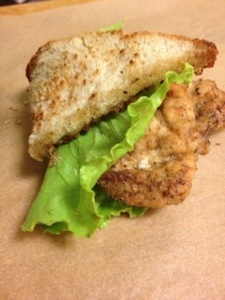
Picnic Chicken Sandwiches

I enjoy the novelty of good road food. I rarely eat and drive-the roads in New Hampshire are too hilly and curvy. But Sam and I planned a road trip to visit his grandmother and I was anticipating 4 hours of flat, straight interstate highway driving. One of my fiend’s mom would pack up a box of these sandwiches for our drive back home after visiting. They’re ideal road food because they are small bites, don’t make a mess, and taste better after being in the car for a few hours.

20130729-063440.jpg

Picnic chicken sandwich

Two boneless skinless chicken breasts with tenderloins.
Penzey’s sandwich sprinkle, or a similar blend of spices.
Flour
Butter
Vegetable oil
Bread
Lettuce
Mayonnaise

Step one. Separate the tenderloin from the breast. Cut the breast into two pieces the short way then cross cut to make four chicken cutlets.

Step two. Liberally sprinkle each side of the chicken pieces with sandwich sprinkle. Pound out the chicken cutlets until they are one quarter to an half an inch thick. Make sure that they are of uniform thickness.

Step three. Dredge the chicken pieces in a light coating of flour.

Step four. Heat a nonstick skillet over medium heat with 1 tablespoon of butter and 1 tablespoon of vegetable oil. Once the pan is hot and the butter has stopped foaming, lay three pieces of chicken into the pan and cook for 3 to 4 minutes on each side, until golden brown. Add extra butter or oil to the hand as the fat is absorbed by the cooking chicken. Set the chicken aside on paper towels to cool.

Step five. After cooking the chicken, lightly toast the bread in pan, using extra butter if needed. Cut into triangles.

Step six. Smear a bit of mayo on the bread (optional, especially if you’re not going to have a cooler to keep your food cool.) Top the bread with a slice of lettuce and a piece of chicken. Fold the bread around the chicken to make a pocket.  Wrap in wax paper and pack up for your picnic.

Edited on Aug 1, 2013 to improve language in step 6.


2 Comments

Blackberry Financiers

(Hand-foraged) Blackberry Financiers. They're "rich." Get it?

(Hand-foraged) Blackberry Financiers. They’re “rich.” Get it?

Yesterday, I went on a hike with Pidi and was fortunate to come upon ripe blackberries. Usually, if I encounter ripe berries on a hike, they go straight from the bush to my lips. But I exercised a bit of self-control (only after I ate a whole bunch of them, standing in the woods…) and brought back home a heaping cupful of ripe, sweet fruits. I was going to freeze them and eventually make some wild-foraged berry jam, but Sam had the fantastic idea of making Financiers.

I got this recipe from Ripe for Dessert by David Lebowitz. For the longest time I couldn’t understand WHY they were called Financiers…

Blackberry Financiers

  • 7 tablespoon unsalted butter
  • 1 3⁄4 cup sliced blanched almonds
  • 1⁄2 cup granulated sugar
  • 1⁄2 cup powdered sugar
  • 5 tablespoon flour
  • 1⁄8 teaspoon salt
  • 4 large egg whites
  • 1⁄2 teaspoon almond extract
  • 6 ounce blackberries (or raspberries or blueberries)
  1. Position the oven rack in the center of the oven and preheat the oven to 400 degrees. Butter a 12 cup muffin tin.
  2. In a skillet, heat the butter until it begins to sizzle. Continue to cook over low heat until the edges begin to darken and the butter gives off a nutty aroma. Remove from heat.
  3. In a food processor, grind the almonds with the granulated and powdered sugars, the flour, and salt. While the processor is running, gradually pour in the egg whites and add the almond extract. Stop the machine, and add the warm butter, pulsing as you pour, until the batter is just mixed.
  4. Divide the batter evenly among the buttered muffin cups and poke 3 or 4 berries into each cake. Bake for 18 minutes, until puffy and deep golden brown. Let stand a few minutes them remove them from the pan to cool on a rack.


2 Comments

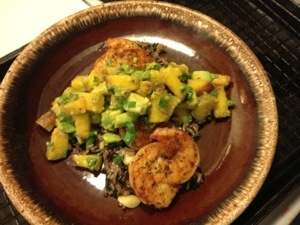
Skewer shrimp for fun and profit

20130713-183816.jpg

Tonight’s dinner was supposed to be fish with fruit salsa. I headed to the coop thinking “tilapia, or maybe salmon…” but was confronted with the Fish Counter Conundrum… The COOP does a good job labeling the origins of fish and seafood, giving information on how the seafood was caught (farmed, netted, hooked, etc) and how sustainable the seafood is: green for good, red for unsustainable. So, yes, I want to do my soft-hearted liberal best to make sure that I Save the World with my purchases… but at the same time, I was confronted with ASTRONOMICAL price differences. Eating sustainable seafood is really damn expensive. This is the Fish Counter Conundrum.

The exception is always shrimp. They’re bioaccumulating biofilters from the bottom of the food chain that live darn near everywhere, can be caught and farmed sustainably, and don’t require a second mortgage to eat. They’re the pigeons of the sea, or the rats of the sea, or something like that… I was able to get 16 shrimp at 12-16 count weight for around $6. They were listed as “sustainable” and had a big green sign saying that I was going to Save the World if I bought shrimp instead of salmon or tilapia.

I cooked them under the broiler (we can’t grill at our apartment) with a big sprinkle of paprika, basil and some cayenne. The fruit salsa was peach and avocado with green onion. Underneath was pilaf with almonds – unremarkable and not quite in line with the dish, but hey… I’m a home cook, not a chef. I get to make-do and write it off as a resources problem.

Squeaky Cheese Curds. Mystery Solved!

2 Comments

Fresh cheese curds are squeaky.

You didn’t know that? Yeah, neither did I, until I had the squeakyness explained…

Thanks to Joe Dobosy and Mich Minoura for explaining squeaky cheese curds, to Hook’s Creamery for jalapino cheese curds, and to Carl Geissbuhler of Brunkow Cheese for explaining why cheese curds are squeaky.


1 Comment

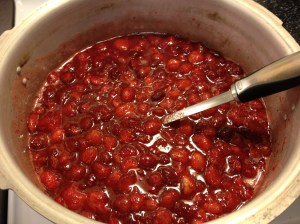
Strawberry Jam

photo

The back-of-the-napkin calculation…

Yielded 25 jars of jam for $4.66 per jar.

Next year, when I don’t have to buy jars, but only have to buy lids ($0.16/lid), each jar will cost me $4.14.

And yes, I didn’t factor in the cost of the equipment that I used – both the general equipment (bowls, spoons) and the canning-specific equipment (canner, jar tongs, lid lifter magnet).

IMG_3457


Leave a comment

Locavore Survival Guide: What is a locavore?

So I need to address the obvious – What is a locavore? The most boilerplate comes from the very first post of this blog – The dictionary definition, “A person whose diet consists only or principally of locally grown or produced food.” There’s two problems I have with this definition. First, it frames locavore as a “diet” and second, the definition leaves “local” to be defined elsewhere. Please excuse me as I pick at nits.

I don’t like diets – in the modern use of the word as a set of guidelines on choosing food, not in the Anthropological meaning of the word as anything that people eat. Diets come as arbitrary sets of rules or guidelines that ossify eating practices and attempt to define the world into “good” and “bad” foods. Lard? Bad. Broccoli? Good. Locally-raised pig lard? Bad (unless you’re a locavore, then it’s good). Conventionally farmed broccoli from Argentina available in New Hampshire in February? Good (unless you’re a locavore, then it’s bad…) I really do NOT want anyone to think there is some list of goods and bads making up the Locavore diet and that you may only eat things on the good list and nothing off the bad list. Diet also emphasizes choosing foods and avoiding foods – a universe of possibility that neglects what you do with the foods you choose or what happens to the foods you avoid. I want locavore to mean more than just choosing foods that are good and avoiding foods that are bad because locavore is more than just the food – it’s about preserving food, cooking food and enjoying food too…

Second, the dictionary leaves out what “local” means. The dictionary defines “local” as “belonging or relating to a particular area or neighborhood, typically exclusively so.” Local as geography. So each locavore is a pin on a map with a circle around it. I don’t much like that either. We can use other definitions of “local” to broaden our understanding of food. I think of food using a network definition. Imagine a network of food producers, packagers, distributors and consumers. Each person or organization is a node and is linked by the transactions between nodes. We all eat within this type of network-I buy a can of tomatoes sold at the coop, shipped by a grocery wholesaler, packages by a plant, picked by a person, grown by a farmer. Alternatively I go to my pantry and get a jar of home-canned tomatoes that I bought at a farm stand that were picked by the farmer. Local, to me, means both geography AND relationship networks. How can we act to minimize both distance and connections?

So, I’m being pedantic, but I want to explore these ideas more fully in this blog… This is why I started in the first place. To gain a better understanding of how and why I eat locally.

So back to my original question: What is a locavore? The dictionary says, “A person whose diet consists only or principally of locally grown or produced food.” Let’s modify this…

A locavore is person who acquires, preserves, cooks and eats food in order to minimize the distance between the food production and consumption.

What do you think?


Leave a comment

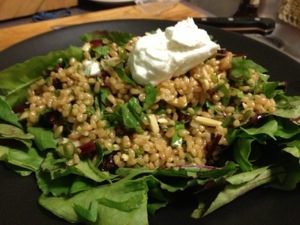
Wheat berry salad with beet greens, almonds, dried cherries and goat cheese

This is a modified recipe from Mark Bittman’s How to Cook Everything called wheat berries with walnuts. I needed to get rid of a whole bunch of beet greens before they went swishy, so I added them. I think given a nice color.

20130610-172911.jpg