ReLocavore: Redefining "local"

Back to Wisconsin, my cheesehead friends


Leave a comment

Mufaletta: We ain’t f*cking around… in Sandwich Form

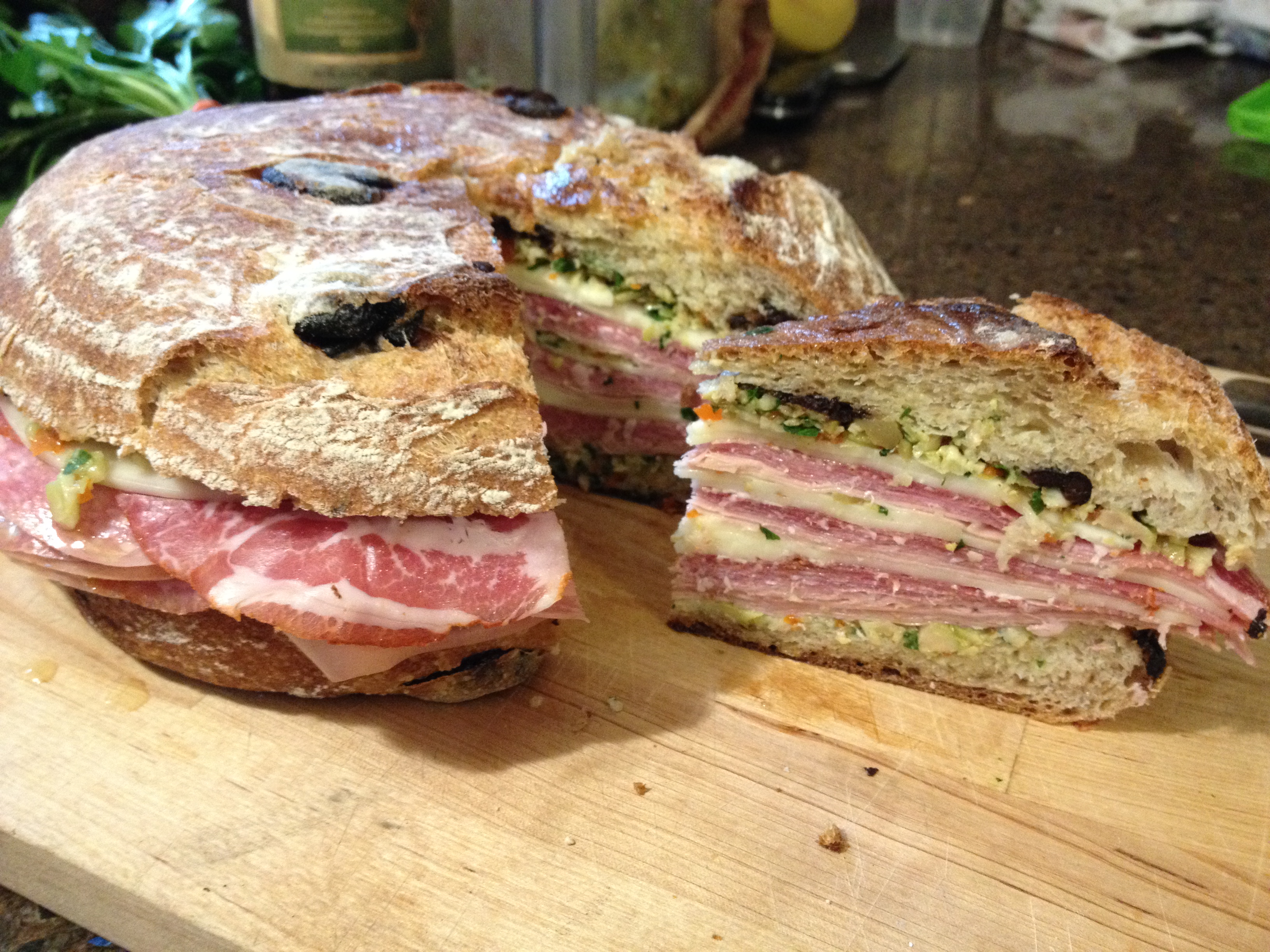
2014-06-22 18.15.05When I want a sandwich, I don’t want a little turkey on bread. I either want chicken salad on a toasted croissant or I want muffaletta. Chicken salad is tempting fate with botulism and celery seeds. Muffaletta is pure NoLa goodness.

A little history, the Central Market in New Orleans supposedly invented the muffaletta sandwich, which is typically mortadella, salami, ham, provolone or swiss cheese on a 8″-12″ round loaf of bread. The real showstopper is the “olive salad” added to the top, which is chopped olives with giardiniera, garlic, herbs and oil. The sandwich is named after the bread – a soft italian loaf with sesame seeds baked into the top, however, it seems silly today to actually just buy the bread… The sandwich is so much better. According to the daughter of the original owner of the Central Market, her father served bread, meat and cheeses to Italian immigrant farmers coming to the market to sell vegetables. Necessity being the mother of invention and all, the sandwich was more portable and easier to eat, rather than balancing the ingredients on one’s lap.

I learned to make a Muffaletta sandwich when I worked as a teenager at the now-defunct Opera House cajun restaurant in Pecatonica, IL. I remember the chef weighting the sandwiches down with gallon-sized metal cans of tomato sauce. I never remember seeing any of the tomato sauce get used in the restaurant – I think the cans were there because they were the right size and weight to make a great muffaletta.
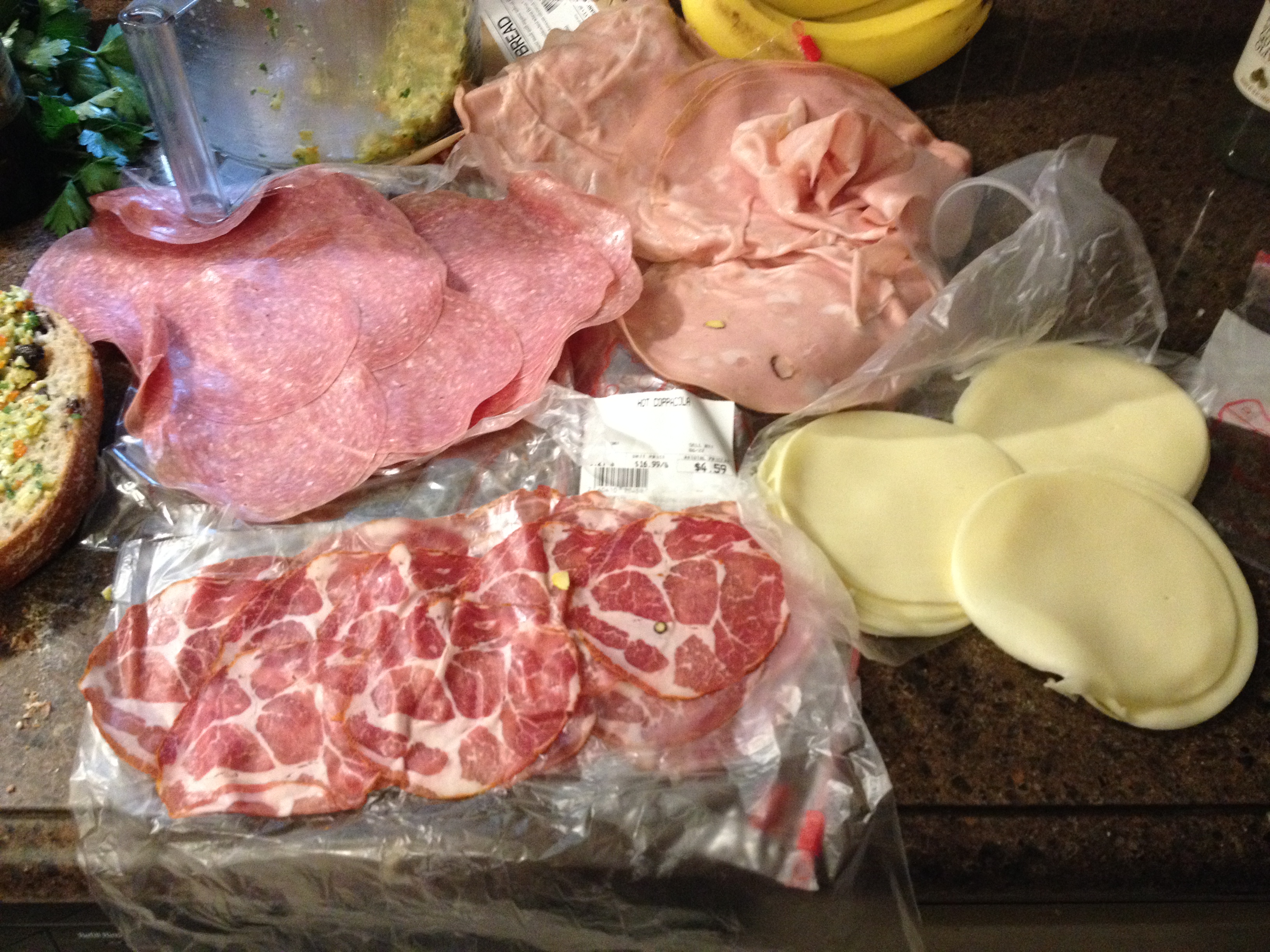
Ingredients: 1/2 lb mortadella, 1/2 lb salami, 1/4 lb hot capricola, 1/2 lb provolone cheese. All sliced thin, but not paper thin. (Not shown: olive tepenade and a large round loaf of crusty bread.)

Ingredients: 1/2 lb mortadella, 1/2 lb salami, 1/4 lb hot capricola, 1/2 lb provolone cheese. All sliced thin, but not paper thin. (Not shown: olive salad and a large round loaf of crusty bread.)


Step 1: Make olive tapenade. In a food processor, combine 3 cloves garlic, 12 oz pimento stuffed olives (drained), parsley, and olive oil. Process until chunky. Cut bread in half and hollow out the top to make more room for sandwich. Spread 2/3 tapenade onto top and bottom of bread.

Step 1: Make olive salad. In a food processor, combine 3 cloves garlic, 12 oz pimento stuffed olives (drained), fresh parsley, and olive oil. Process until chunky. Cut bread in half and hollow out the top to make more room for sandwich. Spread 2/3 tapenade onto top and bottom of bread.


Layer meats and cheeses, and remaining 1/3 of tapenade. Weight sandwich and press for 30 minutes. I'm using the Holy Trinity: McGee, Bittman and Child.

Layer meats and cheeses, and remaining 1/3 of tapenade. Weight sandwich and press for 30 minutes. I’m using the Holy Trinity: McGee, Bittman and Child. Slice into wedges and serve. Wrap leftovers (ha!) and it gets a lot better after a day in the fridge and a trip to the office in your bag.


2 Comments

Fresh Green Pea Soup with Pea Shoots

2014-06-20 18.31.09This past week, we got a bag of pea shoots in our CSA. New vegetable for me. I was just going to put them into a salad and eat them like any other green, but I decided to look around a bit for a good recipe that could feature pea shoots. I found a recipe for fresh pea soup that I was able to make with the pea shoots and a bag of frozen peas from last year. I saved a few pea shoots to put on top of the soup, but the majority of the shoots were cooked with frozen peas and chicken stock, then pureed til smooth.

Of course, pureeing hot soup in the blender, I had a few minor “explosions” and the dog apparently likes the green pea soup – he licked up every last trace from the floor. Good dog. Get your veggies.

Since I avoid the lactose sugar, I used greek yogurt instead of creme fraiche to give the soup some extra body. The process of making yogurt converts lactose sugar to lactic acid, hence, I can usually eat well-made plain yogurt without too many issues.

We served the soup warm, but not hot. I think it would have also been quite tasty chilled.


Leave a comment

Massaging vegetables: Cucumber Sunomono

Cooks Illustrated suggests massaging kale. “Kneading and squeezing” will break down cell walls. They recommend 5 minutes for standard kale and 1-2 minutes for lacinato and red Russian kale.

Here’s the thing… the Japanese technique of sunomono also uses massage to break down cell walls and make vegetables softer and more tender. The difference is the Japanese method includes salt, which helps break down cell walls and extract moisture, but then rinses the vegetables to remove the excess saltiness.

I think this calls for Sunomono, or Japanese cucumber salad! This dish is great on a hot summer day, served with cold soba noodles and iced dipping sauce.

Sunomono

Serves 2 generously.

  1. Peel, cut in half the long way and seed one cucumber. Cut into thin slices on the mandoline.
  2. Mix cucumber and 1/2 tsp salt in a large bowl. Gently rub the cucumbers with salt until they become tender, but not limp, and give away lots of liquid. Gently squeeze the cucumbers to remove any excess liquid. Save the liquid to make a dressing in step 3.
  3. In a microwave-safe glass measuring cup, measure out the cucumber liquid to get 1/4 cup. If theres too much, pour out excess. If there’s not enough, add water. Mix a pinch of dashi granules, 2 tbsp rice vinegar, 2 tbsp soy sauce and a big pinch of sugar in with the cucumber water. Microwave for 30 seconds and stir to dissolve the dashi and sugar.
  4. Arrange half of cucumber slices in the center of a bowl. Pour over a generous amount of dressing, leaving a puddle in the bottom of the bowl. If time allows, chill to be ice-cold.


3 Comments

This Week in Veg: A Cucumber is a fruit…

IMG_8074


We got two new and exciting things in the CSA this week: Cucumbers and Russian red kale.

The Cucumbers are the bearer of good news – Summer is almost here. They’re the first “vegetable” that we get each season that really needs some sun to grow. The turnips, asparagus, radishes, and bok choi that we’ve got over the last few weeks are cool-weather crops.

The red Russian kale is a fad, I think. Is there some local restaurant that’s doing something fancy with this type of kale? What ever am I going to do with an entire bag?


Leave a comment

Yamaimo or Snot Potato

This is my first experience with yamaimo, mountain yam or slippery potato – I will affectionately call it the snot potato. Recipes for Japanese Pizza or Okonomiyaki call for a tablespoon or more of grated snot potato and grating it produces a thick mucilage which makes okonomiyaki pancakes more stretchy and elastic. See the video for proof of snottiness. On our recent trip to Boston to shop the Asian markets, we came home with a 4″ piece of yamaimo and were able to use it to cook okonomiyaki.

As far as I can tell the snot potato doesn’t have any noticeable taste or smell. But it did make our okonomiyaki more elastic and gave it a chewy texture.

Thanks to Gypsy Swing Revue for the music.


1 Comment

The least local thing we eat – Japanese Foods

Sam and I have a love for Japanese food. I don’t quite know where it all came from, but we’ve incorporated a lot of key Japanese foods into our diet, and we are always exploring new Japanese dishes. Warning flag… This is NOT a post about local foods. This is actually a post about the least local thing we eat… Nonperishables imported from Japan. Claims of locavore hypocrisy are welcome in the comments!

Sunday, Sam and I took a trip to Boston to scout out the Japanese and Asian grocery stores and came home with a mess of pantry staples. There are a lot of key pantry staples that we just can’t substitute. Maki at JustHungry has a great review of what these basic foods are and how to cook with them. 

1. Yamasa soy sauce. 2.

1. Yamasa soy sauce. 2. Kombu, dried kelp used in making dashi stock. 3. Hiyashi chuka noodles: Sesame vinegar dressing with hot mustard. 4. Brown sushi rice. 5. Hon mirin. Not the shitty corn syrup stuff. 6. Fried tofu pockets for making inarizushi. 7. eggplant pickles (the only way I will eat eggplant). 8. More noodles. 9. Cucumber pickles. Totally unlike all American Kosher Dills. 10. Tonkatsu sauce. 11. Takuan, pickled daikon radish. 12. Ripping hot spicy mustard. 13. Salmon Furikake. It’s a mix of sesame, nori (seaweed sheets), and dehydrated salmon that you shake on top of rice or tofu. 14. A foam skimmer. It’s a joke. I’ll explain later. 15. Yamaimo or slippery potato or mountain yam. 16. Botan rice candy. 17. Ume plums. Pickled apricots with a minty herb called shiso. 18. Beni Shoga, or pickled ginger. Unlike the stuff at sushi bars, this has no added sweetener and is a little salty. 19. Fish cake. This is pollack that is died and pressed into shapes. I serve it in noodle dishes. 20. More noodles, but this kind is fresh instead of dried. 21. Kouya dofu, or freeze-dried tofu. I’ll use it to make mochi nuggets, like vegan chicken nuggets. 22. More fish cake, but this time extruded into a log with a pink spiral shape.

We visited two different Asian groceries:
Ebisuya Japanese Market in Medford, MA.
65 Riverside Ave Medford, MA 02155
781-391-0012
info@ebisuyamarket.com
This was a Japanese-only grocery store and where we bought about 90% of our pantry staples. They had some fresh foods, but mostly shelf-stable foods. They were operating a busy fish counter and had a sushi bar attached to the grocery. The whole store was the size of a big convenience mart. I was very impressed with the selection of foods at Ebisuya. Someone with a great love of Japanese food is making sure the Japanese of Boston metro area have access to fine-quality imported foods. They even had fresh green ume plums!

H Mart
43 Middlesex Turnpike, Burlington, MA 01803
781-221-4570
H Mart is the Big Box asian grocery. Frankly, it was very intimidating to be there on a Sunday afternoon – the whole store was PACKED with customers. There was a wait for parking. H Mart is mostly Korean goods, but they carry a lot of Japanese foods as well, due to the overlap between the cuisines. We only picked up a few items there because Sam and I were both completely overwhelmed by the size and business of the store. We’ll try to go back midweek and midday and hopefully it’s not so crazy. I think we could find everything we wanted there, and the prices were about comparable to Ebisuya. H Mart does have a large produce section, if we’re wanting produce for whatever reason.

Over the next few weeks, I’ll be posting some videos and explanations of how I use a lot of these foods in my cooking.


Leave a comment

Eggs at the Norwich Farmer’s Market

https://flic.kr/p/6q2of3At the Norwich Farmer’s Market there are a handful of stands that sell eggs, along with other produce and meats. I talked to all of the egg vendors on May 31 and here’s the info they gave me about their eggs. This year, the average market price is $4.50. Compared to last year, the Norwich farmer’s market has more egg producers (3 in 2013, 7 in 2014) and the average price per dozen increased from $4.17 in 2013 to $4.50 in 2014. I’m going to visit the groceries the area to get a sense of the price per dozen for conventional and high-end eggs.

Farm Price per
Dozen
Laying Hens Free Range Feed
Highfields Farm $5 100 Yes Pasture
Organic Grain
Ephraim Mountain Farm $4 200 Yes Organic Grain
Thymeless Herbs $4 100 Yes Scraps from the COOP
Pasture
Minimal Grain
Hogwash Farm $5 Yes Organic Grain
Rabbit Patch Farm $2.25 sm
$3.50 large
$4 jumbo
200 yes Pull pellet
Corn
Fat Rooster Farm $4.50 30-50 Yes Mixed grains
Pasture
Scraps
Luna Bleu Farm $5 120 Yes Organic Grain
Pasture


Leave a comment

The new garden

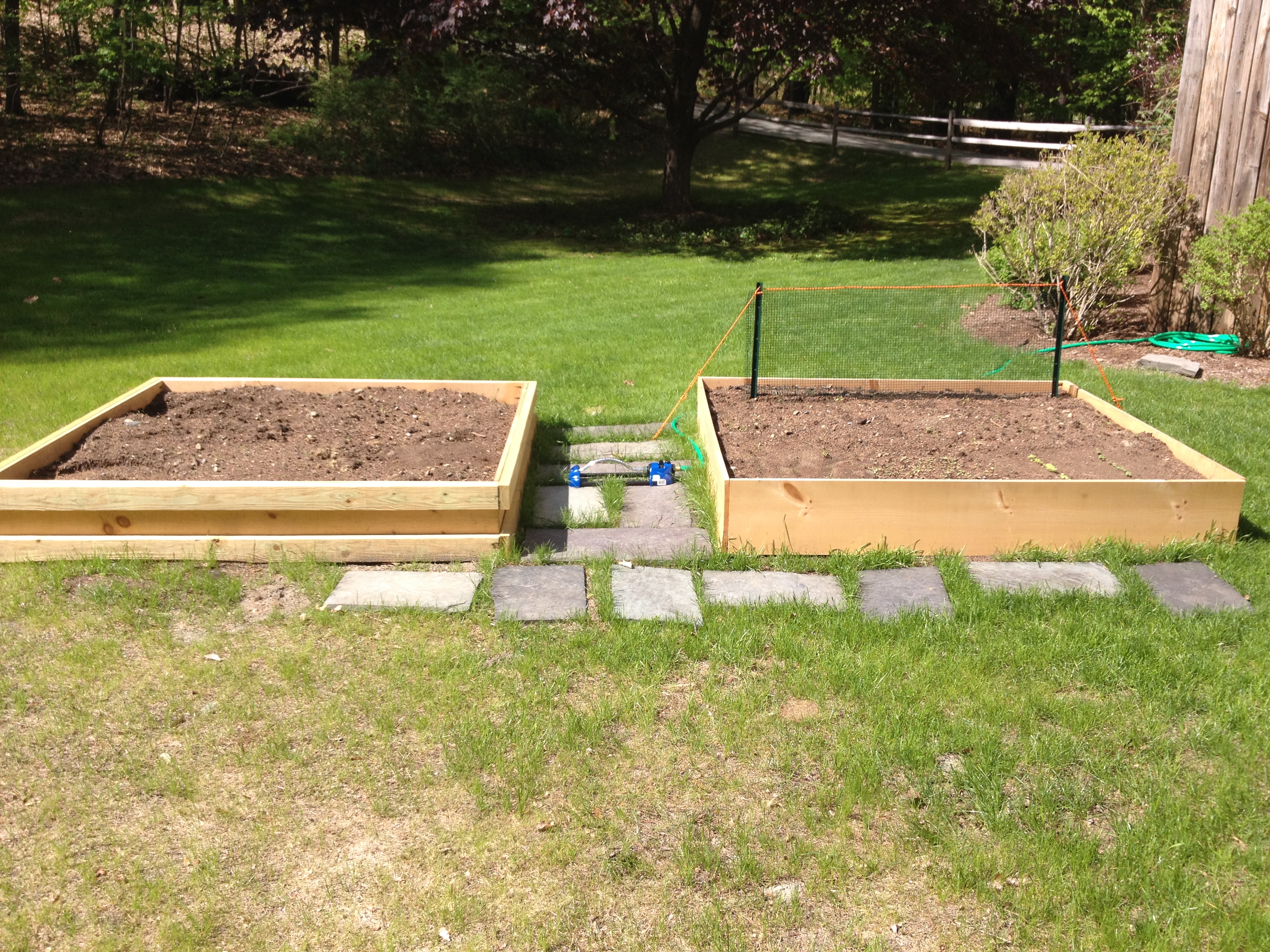
Sam and I have been dreaming about having a garden again. Finally, we dug up some sod, had a pile of topsoil delivered, and built some raised beds.

Sam took 1 by 12s to build the sides of the raised beds, and reinforced the sides with 2x4s. Each bed is 6’x6′, giving us 72 square feet of garden, or a measly 0.002 acres. We also found leftover flagstones on our property left by the former owners. We used them to line the path between the beds. It’s a start.

The left bed is partially planted. You can see the different seed beds and the pea trellis we put up. The right bed is taking longer to shape up because it’s mostly going to be full of transplanted tomatoes.

2014-05-21 15.11.59

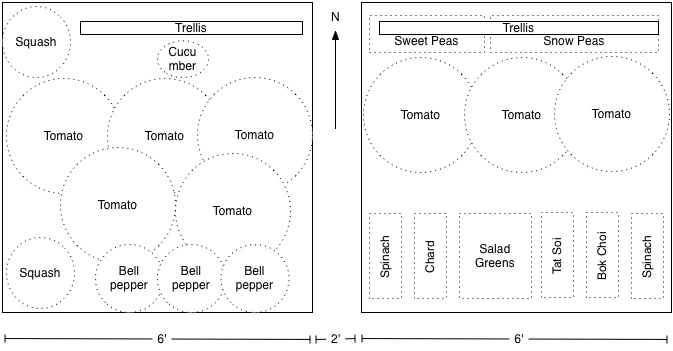
Layout


Here’s the current garden plan. We’ve planted the greens and peas, and one of the squashes. Since I’m not setup to start seeds indoors, I’ll be buying transplants for my tomatoes, peppers and cucumbers. More pictures when everything goes in and the big deer fence goes up.