This year I didn’t go wild with the Christmas cookies. Frankly, we don’t know enough people here to offload so many cookies!
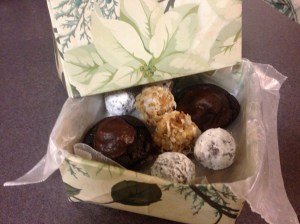
Christmas cookies, packed up in a paper box, ready for delivery.
Date balls with toasted coconut.
Chocolate covered cherry cookies. This recipe came to our family through a friend who had recently moved to the United States from Japan. This recipe was in her cookbook to teach Japanese women how to cook like American women. American women would never cook a recipe with so many steps.
Rum balls. Basically ‘Nilla wafers, chocolate and rum, rolled in powdered sugar.
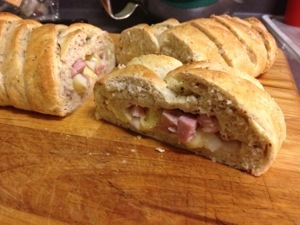
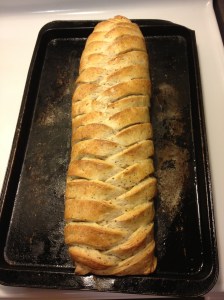
My mom used to make this sandwich when we were kids, but I think she must have filled it with rutabagas, turnips, and lindberger cheese, because I never really liked it as a kid. However, this recipe is GREAT for grownups, especially grownups who would like to put together something showy to take to a potluck. Mom’s recipe came from some Fleishmann’s cookbook or advertisement – the recipe, as she wrote it, calls for Fleishmann’s yeast by name. I made it with a rough-ground mustard so my dough was speckled with mustard seeds.
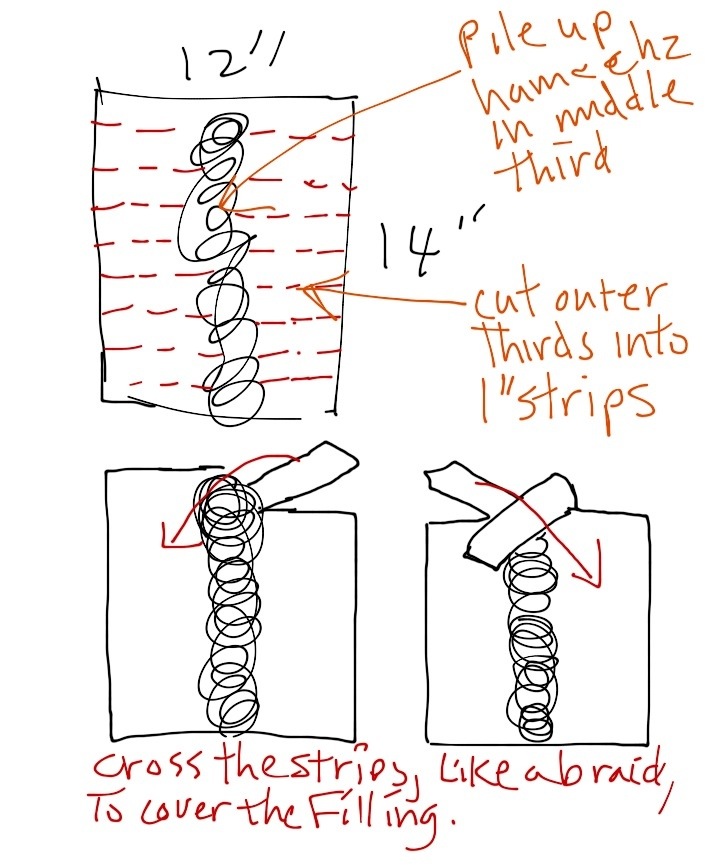
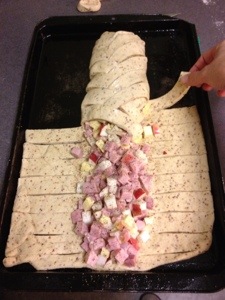
I hope that I can use the technology of the internet to help show you how to make this sandwich. I took some in-progress pictures, plus I made a hastly drawn diagram on Penultimate on my iPad. If you don’t get it, I’ll make this again and post a video to Youtube.
(Smother’s Leftover Makeovers, p29.)
4 cups (560g) AP Flour
2 Tbsp sugar
1/2 tsp salt
1 cup water
1/4 cup dijon mustard
2 Tbsp butter
2 packages (14g) rapid rise yeast
1.5 cups cubed ham (1 cm/ 1/4 inch cubes)
1 cup cubed apple
1 cup cubed cheese (I used cow’s milk cheese from Cobb Hill Farms)
Mix flour and salt. Reserve 1 cup flour/salt mix.
Mix water, mustard, sugar and butter in a glass measure cup. Microwave until butter is melted and temperature reaches 125 to 130F.
Add flour to bowl of the stand mixer with the paddle attachment. Drizzle in the liquid until a wet dough forms. Switch to the dough hook. Knead for 4 minutes, adding in the additional 1 cup of flour/salt to reach a firm dough. Let the dough rest for 10 minutes so the glutein relaxes.
Heat the oven to 375F.
Reserve a golf-ball sized piece of dough. Roll the remaining dough out to a 14″x12″ rectangle. Transfer the dough to an oiled baking sheet. Pile the cubed meat, apple and fruit along the middle third of the dough. Cut the outer thirds of the dough into 1″ strips. Fold the strips over to cover the filling, like making a braid. Roll the golf-ball sized piece of dough into a disk, and use it to “plug” the sandwich on the end where you started braiding – the filling won’t fall out this way.
Put the sandwich someplace warm and let the dough rise for 15 to 20 minutes. Brush the sandwich with a beaten egg, making sure to cover the edges and any dough peeking through the braid.
Bake the sandwich in the middle of the oven for 25-35 minutes, rotating halfway.
Let the sandwich sit for 10 minutes to let the cheese firm up before slicing. Serve warm.
(Frontnote: Yes, I know it’s paté. But I’m going to type pate. Sorry… it’s extra keystrokes.)
We’re going over for a Christmas get-together at a colleague’s house this afternoon. I needed to bring something, and I only know two mushroom finger foods. Mushroom pate and marinated mushrooms. I chose the former. I make this as part of my vegan crudite platter: mushroom pate, cashew cheese, and olive tapenade with pita chips and sesame crackers. Invite me to a party sometime to try it out!
This isn’t my recipe, so I’m not going to replicate it here. (I want other people to respect my copyright as I respect theirs.) I think this is the original recipe I have been using – the proportions seem right. The main ingredients are sauteed mushrooms, onions and garlic, flavored with cumin and curry powder (just a teaspoon of each), pureed in the blender with toasted cashews and a little peanut butter. The onion, garlic and spices add a little depth to the flavor and the cashews and peanut butter give the recipe better body. Pureed mushrooms would just be a mess.
I would usually make crackers to go with this dip, based on the excellent recipe for Olive Oil and Seed Crackers from Clotilde Dusoulier at Chocolate and Zucchini. I admit tho, I had no interest in spending a few hours in the kitchen rolling out dough, so I bought some crackers from the COOP that were basically a scaled production of what I wanted to bring… Intention counts, right?
I’ll catch a photograph later today when I’ve got the pate set out with the crackers. Right now it’s in a bowl under plastic and looks rather grey and unpalatable.
My photography leaves much to be desired. This dish was not as orange as this photo makes it out to be.
The recipe for tonight’s dinner we made up from scratch. We had stuff around the house to make stir fry, but we didn’t quite know how to flavor it. Sam wanted lemon, but I wasn’t in the mood for something tart. By coincidence, we had bought a jar of orange marmalade at the COOP yesterday. TA DAA! A nice complement to hoisin sauce.
In addition, this recipe illustrates one of my favorite cooking techniques – velveting. I learned this technique from the Cooks Illustrated recipe “Marinated Velveted Chicken Stir Fry” from May 2004. Velveting is a common technique used in Asian styles of cooking, but somehow Americanized versions of Asian recipes morphed into “breading.” Take the basic Chinese restaurant-style of preparing sweet and sour chicken: pieces of chicken are dipped in batter and deep fried, producing a breading that soaks up the sweet and sour sauce. Velveting is the same principle, but doesn’t involve the deep frier and produces (I think) a better coating on the chicken (or tofu, in this recipe). In general, velveting involves tossing uncooked meat or tofu in a mixture of oil and cornstarch, coating the meat in a very thin batter-like coating. The meat or tofu is then cooked in a hot pan with very little oil, producing a coat of partially-cooked cornstarch around the meat or tofu. The meat or tofu stays moist because the coating keeps the meat from coming in direct contact with the pan. Then a thin sauce is added to the hot pan, and the sauce combines with the uncooked cornstarch to make the sauce thick and the meat coating “swollen” and rich-tasting. The end product is similar – tender pieces of meat with a thickened sauce. I make most of my stir-fries using this technique. Caveat: it doesn’t work well with fatty beef – the fat makes the coating come off.
Orange Hoisin Tofu
5 carrots, julienned
1/2 head napa cabbage, stems and leaves separated, cut into 1cm shreds
1 block firm tofu, pressed. cut into 1cm x 1cm x 5 cm strips
1 tbsp corn starch
1 tbsp vegetable oil
1 tsp sesame oil
1 tbsp rice wine vinegar
1 tbsp minced ginger
2 cloves garlic, minced
2 tbsp orange marmelade
2 tbsp hoisin sauce
1 tbsp soy sauce
1/2 cup chicken stock
vegetable oil for stir frying
Mix cornstarch, vegetable and sesame oil in a large bowl. Add tofu strips and gently toss to coat.
Heat a nonstick pan on medium-high heat. Add a small amount of vegetable oil and swirl to coat the pan. When the oil shimmers, but not smokes, add the tofu in a single layer. (You may need to cook the tofu in two batches.) Don’t shake the pan around – just let one side of the tofu get nicely browned. Methodically turn all of the pieces of tofu to the second side, and again leave the pan alone and let the second side cook. I know this doesn’t seem very stir-fry like, but it’s important to evenly cook the tofu so the breading sticks. If you’re more patient than I am, you can cook the other sides of the tofu, but I usually only cook 2. Put the tofu into a bowl and set aside.
Add a small amount of oil to the hot pan, again swirl to coat and wait for the oil to shimmer. Add the carrots and the napa stems. Toss in the pan to cook about a third of the way to done. Add the cabbage leaves. Splash the vinegar into the pan and QUICKLY cover with a lid. This steams the cabbage leaves. Leave the lid on for a half a minute, then remove and toss the vegetables to spread around the vinegar. When the vegetables are about halfway cooked, tender but still firm, transfer into a bowl and set aside. They’ll keep cooking in the bowl, so pull them off early… Mushy vegetables are yucky in stir fry.
Now to build the sauce. Add a small amount of oil to the hot pan, but leave it in a puddle. When the oil shimmers, pull the pan off the heat. Turn the burner down to medium-low. Add the ginger and garlic into the oil and stir around until everything smells good – 30 seconds maybe? With the pan still off the heat, add the hoisin and marmalade and mix together. Return the pan to the heat (now on medium-low) and let the ingredients cook together until bubbly – a minute or two. Add the chicken stock and stir. Bring the sauce to a simmer.
This is based on this recipe making 2.5 servings (two dinners and one half-sized lunch).
Once the sauce is simmering, add the tofu. Gently stir the tofu and sauce to coat all of the sides of the tofu. Bring the sauce back to a simmer – the sauce should thicken slightly. Once the sauce has thickened, add the vegetables and gently stir to coat the vegetables with sauce.
(As a sidenote, until I wrote this post, I thought it was spelled “marmelade.” Learn something new every day!)
So there’s this big controversy about washing mushrooms. I don’t quite understand, honestly. Some people think washing mushrooms will make them slimy, so they brush the mushroom to get any attached dirt off the outside. Other people don’t wash mushrooms because they expect mushrooms to absorb water, hence diluting the flavor of the mushroom. Alton Brown, of Good Eats fame has, in my opinion, debunked this “myth” of mushrooms. He methodically washed and soaked mushrooms, and was able to demonstrate they did not soak up much water: an increase from 4.0 oz to 4.2 oz, for an increase of 0.2 oz, 5% of their weight, or about a teaspoon of water. Mushrooms soak up a trivial amount of water when they’re washed. When I cook with mushrooms, I make sure to rinse off the dirt using the sprayer in the kitchen sink. However, mushrooms that have been washed need to be used – they can’t be washed and stored.
Mushrooms store poorly in the “fresh” state. Since mushrooms are made up of so much water, the dry climate of the fridge sucks their moisture out. I keep my shrooms in a tightly closed paper bag in the fridge. They seem to do okay for 4-5 days.
Since mushrooms are made up of so much water, drying them is a great way to concentrate their flavor and preserve them for a long time. I haven’t dried my own mushrooms, but I’m sure PFB has a chapter or two on the process. I have used dried mushrooms for a number of different dishes. Dried porcini have a wonderful flavor, and make a rich broth when reconstituted. Japanese dashi stock often uses dried shiitake mushrooms to add flavor. Cooks Illustrated is also enamored of using powdered dried mushrooms (usually shiitake) to thicken dishes and add rich “meaty” flavor.
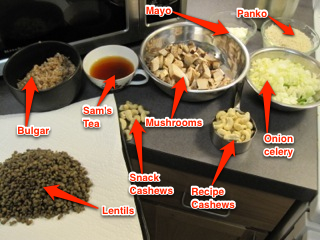
Mise En Place… with a bit of tea and snacking along… Annotations made with Skitch.
EDIT: There’s pictures now… Now I can only apologize for the lack of a final picture of a cooked burger.
So, I’ve found there’s two types of “mushroom burger” – the first is a portobello cap between a bun – a grilled mushroom cap sandwich, as it were. The other is macerated mushrooms with other stuff, made into a patty, and eaten between a bun. This recipe the latter type. But, since it’s a Cooks Illustrated recipe (yet again!) there’s a LOT more to it.
Disclaimer: I didn’t do much of the cooking tonight. Sam had the day off, so he did 95% of the cooking. My contributions were: microwaving frozen peas, opening a can of corn, microwaving said corn, and toasting burger buns. So much of this post is based on Sam’s narrative of making of mushroom burgers.
As an aside, all Cooks Illustrated recipes are sometimes more complex than they need to be… This is the extra work the writers at Cooks put into developing recipes that are reliable, not simple. Cooks is NOT concerned with novice chefs that can’t read a recipe. They expect you to know your way around your well-equipped kitchen. That being said, all of the reliability of their recipes comes with a trade off. Sometimes the steps seem completely unnecessary and pointless. (note my discussion about rehydrating porcini mushrooms from Tuesday) But, when I’m cooking one of their recipes, I follow their instructions religiously.
Onto the mushroom burgers (So says Sam)… Sam doesn’t think this recipe made a “mushroom burger,” just a really good “veggie burger.” There wasn’t enough mushroomyness for him. In the recipe, the mushrooms were only one of four main components. The recipe called for lentils, bulgur wheat, and pakno breadcrumbs, with mayonnaise to bind it together. So the overall impression was not “mushrooms” it was “patty of stuff.” We brainstormed how to make the whole thing more “mushroomy” and the only good idea we could come up with was to use dried shiitake mushrooms ground to a powder as a binder and a way to absorb more moisture. I also though about a “stuffed mushroom burger” where a portobello cap was grilled, then stuffed with mushroom filling and finished under indirect heat, and served on a bun. It would be a hybrid of the mushroom cap sandwich and the veggie burger.
So they’re a time-consuming but tasty substitute to Gardenburgers. We’ll have to do some tests to see how well the formed patties can freeze. Having these on hand in the freezer would make me more likely to cook them again. I’ve come to expect veggie burgers to be a quick dinner, not a 45-minute prep that required the food processor.
Sorry for the lack of pictures – I didn’t take any since I wasn’t cooking. There’s a few pictures hiding on the actual digital camera (I take all my photos on my iPhone), but I don’t know how to get to them…
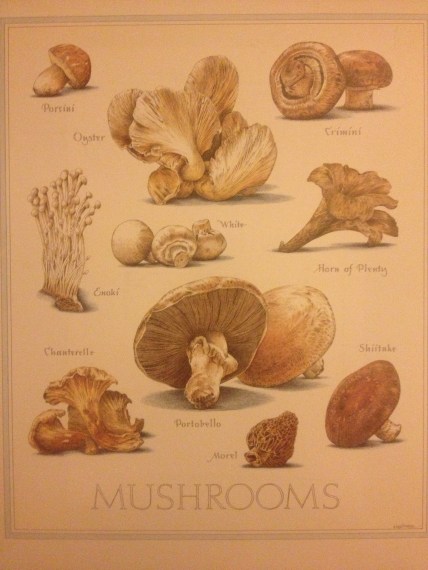
This is a mushroom poster we have framed on our wall. It is from the back cover of Cooks Illustrated Magazine.
I have eaten the following mushrooms:
Basic white button mushrooms. They come fresh and canned. I love to add them to my chili.
Crimini. Little portobello mushrooms. A good all-purpose mushroom. When I make mushroom pate, I only use crimini.
Portobellos. Big portobellos. 3-5″ cap and a thick stem.
Puffballs. These are BIG 12″ spherical, white mushrooms that grow wild. If you can get them when they’re very white, they cook up like scrambled eggs.
Morels. A rare treat for the early spring. Nobody seems to have figured out how to grow them commercially, so the best place to get them is at farmer’s markets. They’re funny-looking and go GREAT with brown butter.
Porcini. I’ve never had these mushrooms fresh, only dried. They have a wonderful woodsy scent.
Shiitake. A japanese mushroom with a wide, thin cap and a narrow stem. I have had them both fresh and dried.
Enoke. Another japanese mushroom that comes in bunches. It’s mostly stem with just a little tiny cap.
Once I had figured out basics of Mushroom biology, I wanted to know what are they made of? Are they meat or vegetables? How much protein and fiber do they contain?
The main stuff that makes up mushrooms is a protein called chitin. It’s a protein that is also found in insect exoskeletons. Hmm… There’s also other nutrients that occur in small amounts and vary according to th e
I looked up mushroom nutrition in the USDA nutrition database. It seems there’s not much of anything in mushrooms. Based on plan-old white button mushrooms, an 8 oz serving (about a packed cup of chopped mushrooms… or three portobello caps. A lot of mushroom) is only 50 calories. Most of the nutrition is from fiber (2.3 g) and protein (7.0g). Compare this to 8oz of flank steak (lean beef) has 440 calories, mostly fat (18.9g) and protein (63.5 g). Really, mushrooms are a fibrous network to hold water.
In the taxonomic world of living things, there are 5 kingdoms: animals, plants, fungi, protists (called eukaryotes when I was in school), and prokaryotes. Mushrooms are fungi – an entire KINGDOM of foods to discover and eat! We are very familiar with yeasts and their culinary properties – yeasts are single-celled organisms that eat sugar, belch gasses, and make bread and beer. Molds are another type of fungi – think blue cheese, penicillin and shower curtains. Mushrooms are only one part of the remaining kingdom of fungi.
The thing we thing of as the “mushroom” is often the “fruiting body” of a vast structure that makes up the entire fungus. The mushroom part comes together, raises up out of the ground and releases spores – part of the way the mushroom can reproduce. We are not going to discuss how this type of reproduction relates to human reproduction, or else I’ll get the giggles…
So the mushroom often has “gills” where the spores are kept. The gills provide lots of surface area to distribute the spores. In my opinion, gills get in the way of culinary goodnesss, so I often scrape them out, especially in big portobello mushroom caps.
The big difference between fungi and other organisms is that fungi break down other organisms for their own nutrition. Animals eat plants and other animals. Plants get energy from soil, water and sunlight. Fungi eat everything, breaking down dead material into it’s basic components, then rebuilding it to feed themselves. It’s kind of like Minecraft… Except with fewer Creepers.






 ReLocavore: Redefining "local"