29.6 lbs for $2/lb. 4 Corners Farm.
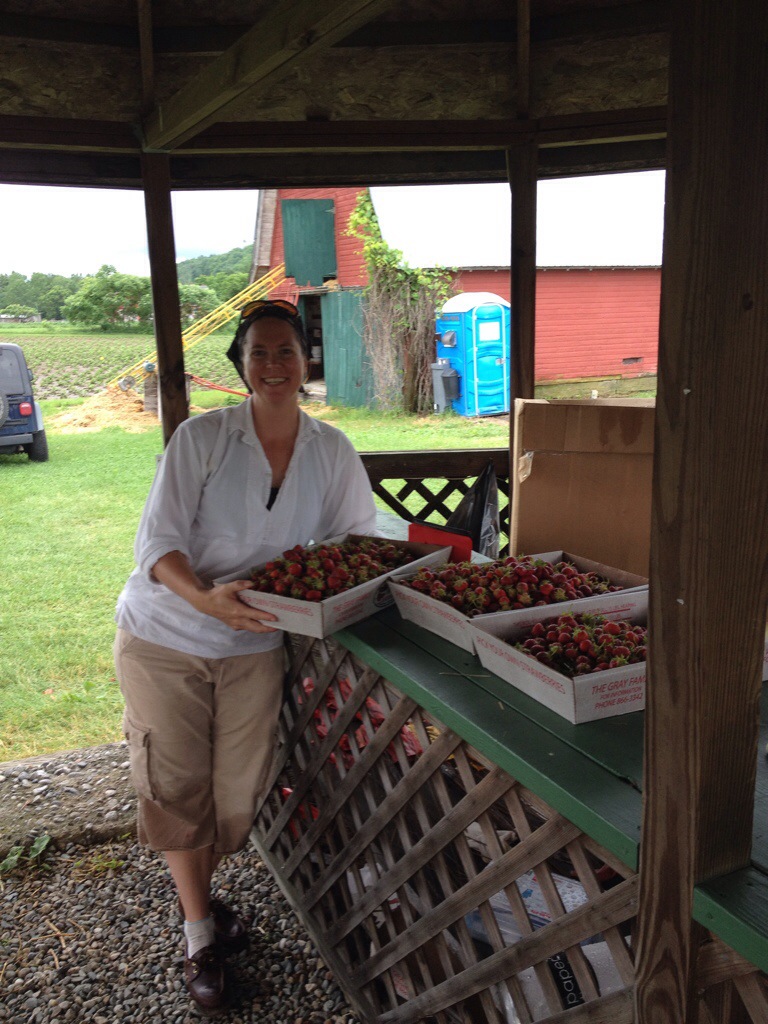
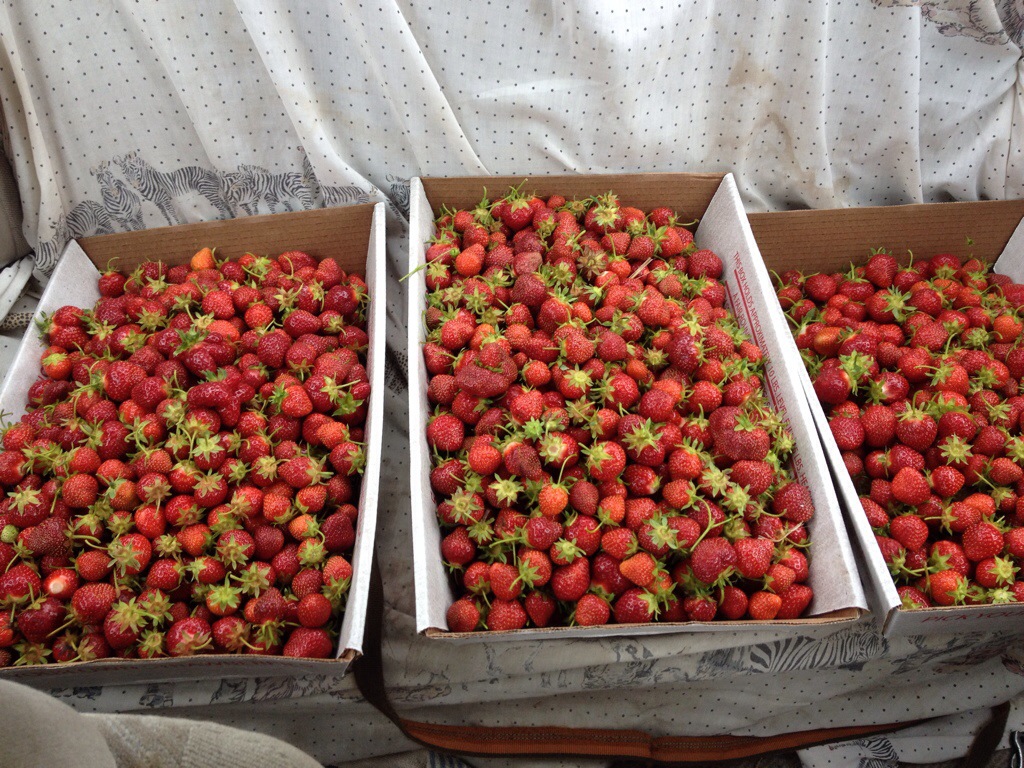
29.6 lbs for $2/lb. 4 Corners Farm.
 This past week, we got a bag of pea shoots in our CSA. New vegetable for me. I was just going to put them into a salad and eat them like any other green, but I decided to look around a bit for a good recipe that could feature pea shoots. I found a recipe for fresh pea soup that I was able to make with the pea shoots and a bag of frozen peas from last year. I saved a few pea shoots to put on top of the soup, but the majority of the shoots were cooked with frozen peas and chicken stock, then pureed til smooth.
Of course, pureeing hot soup in the blender, I had a few minor “explosions” and the dog apparently likes the green pea soup – he licked up every last trace from the floor. Good dog. Get your veggies.
Since I avoid the lactose sugar, I used greek yogurt instead of creme fraiche to give the soup some extra body. The process of making yogurt converts lactose sugar to lactic acid, hence, I can usually eat well-made plain yogurt without too many issues.
We served the soup warm, but not hot. I think it would have also been quite tasty chilled.
Cooks Illustrated suggests massaging kale. “Kneading and squeezing” will break down cell walls. They recommend 5 minutes for standard kale and 1-2 minutes for lacinato and red Russian kale.
Here’s the thing… the Japanese technique of sunomono also uses massage to break down cell walls and make vegetables softer and more tender. The difference is the Japanese method includes salt, which helps break down cell walls and extract moisture, but then rinses the vegetables to remove the excess saltiness.
I think this calls for Sunomono, or Japanese cucumber salad! This dish is great on a hot summer day, served with cold soba noodles and iced dipping sauce.
Serves 2 generously.

We got two new and exciting things in the CSA this week: Cucumbers and Russian red kale.
The Cucumbers are the bearer of good news – Summer is almost here. They’re the first “vegetable” that we get each season that really needs some sun to grow. The turnips, asparagus, radishes, and bok choi that we’ve got over the last few weeks are cool-weather crops.
The red Russian kale is a fad, I think. Is there some local restaurant that’s doing something fancy with this type of kale? What ever am I going to do with an entire bag?
https://flic.kr/p/6q2of3At the Norwich Farmer’s Market there are a handful of stands that sell eggs, along with other produce and meats. I talked to all of the egg vendors on May 31 and here’s the info they gave me about their eggs. This year, the average market price is $4.50. Compared to last year, the Norwich farmer’s market has more egg producers (3 in 2013, 7 in 2014) and the average price per dozen increased from $4.17 in 2013 to $4.50 in 2014. I’m going to visit the groceries the area to get a sense of the price per dozen for conventional and high-end eggs.
 This week we got arugula, bok choi, asparagus, dill, green onions, hakurei turnips and new potatoes. Compared to last year, we hadn’t even started getting CSA deliveries.
Anybody have suggestions on what I can make with a pound of arugula?
 A few weeks ago, I started the Sauerkraut – or the salted, shredded cababbage as it was known back then… Now it’s matured into full-fledged sauerkraut. And it tastes like sauerkraut. It has a little bit more character than store-bought kraut, especially because it has less salt and because I haven’t applied any heat to kill off the culture. Otherwise, it’s mostly interchangable with the store-bought product.
In total, we had 4 pounds of cabbage and that became 1 quart and 1 pint of finished kraut. (6 cups for the non-canning inclined).
That’s just enough for a batch of Cabbage Rolls and one dinner of kielbasa, mashed potatoes, and sauerkraut.
Now I have to figure out what to do with 4 pounds of red cabbage…
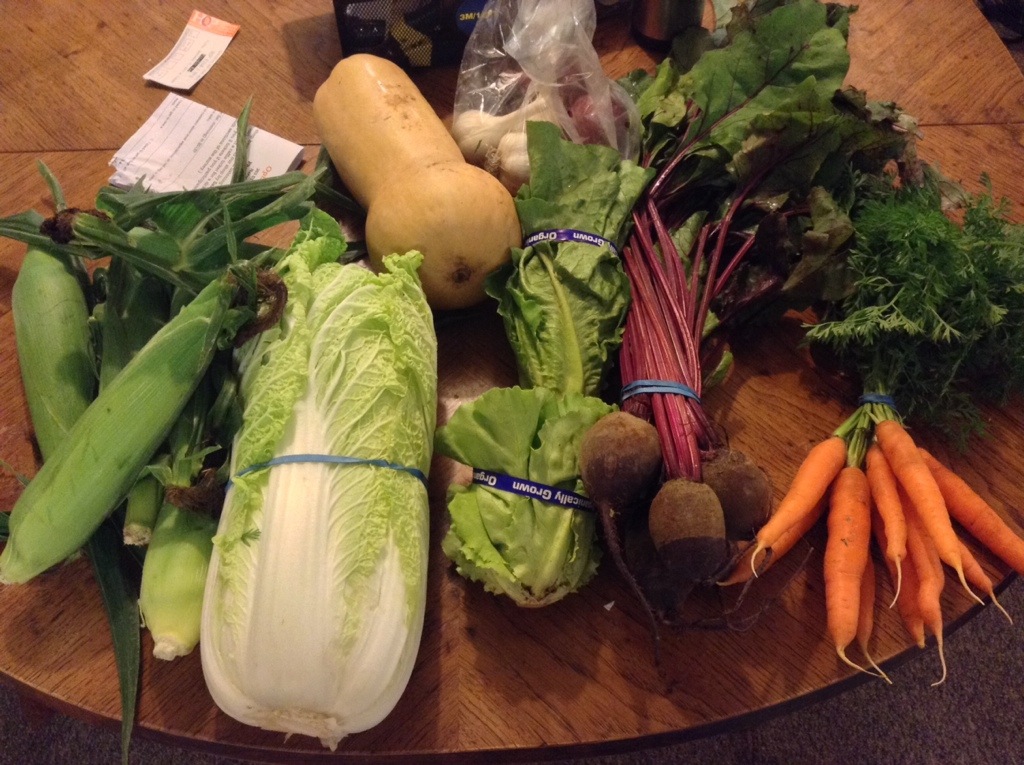
This is the last week of vegetables from Cedar Circle. In the fall, Cedar Circle transitions to a pick up CSA model, where we would have to drive up to their farm every other week to pick up our vegetables. We decided the extra driving lessons so worth it, so we signed up with a different CSA for the fall/winter share.
I’m surprised to see we continue to get corn from the farm. There’s also a tiny little head of butter crisp lettuce, which I love to make into Thai style lettuce wraps.
I get the heirloom tomato craze. Heirloom tomato plants are hardy and disease-resistant, and the fruits are colorful and flavorful.

However, there’s something to be said for boring-old red tomatoes. I mean… look at how WEIRD the heirlooms look when you can them!
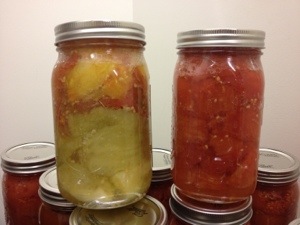 (Heirlooms on the left. “Standard” tomatoes on the right.)
I make boring tomato sauce. By “boring” I mean “plain.” I don’t jazz it up with too many spices, or add chunks of tomato, mushroom, red pepper… It’s basically reduced tomato puree with some minimal seasoning. There’s a reason for making boring sauce. Interesting tomato sauce – with mushrooms, meat, vodka, roasted red peppers, fresh basil, etc… is only useful as tomato sauce… you put it on pasta. You make lasagna! Voila! But boring tomato sauce is infinitely versatile. I can add cumin, oregano, vinegar and sriracha and turn out a decent enchilada sauce. Add stock and it becomes a tomato soup base. Reduced with vinegar, ketchup, and mustard and it becomes barbecue sauce. Tonight, we combined the sauce remaining after filling the jars with sausage, shrimp and rice and had jambalaya. I can still add mushrooms or roasted red peppers and dump it on pasta… Boring tomato sauce is like the pluripotent stem cell of the tomato world. (Well, technically the tomato is the pluripotent stem cell of the tomato world, but… the metaphor isn’t great… so sue me.)
 Pureeing tomatoes is a fun process with the food mill attachment to the Kitchenaid Stand Mixer. I estimate that I pureed 20 lbs of tomatoes into about 14 to 15 quarts of tomato puree.
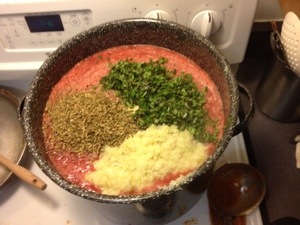
Clockwise from the top is 1/2 cup chopped fresh basil, 3 onions chopped and 5 cloves of garlic through the press and sautéed until soft, and 1/4 cup dried oregano. Not shown is brown sugar, salt and pepper.
We started the sauce about 8pm on Saturday, and cooked it overnight in the oven. Then, in the morning, it went back on the stovetop to cook through until about 3pm. Typically, we would have cooked the sauce overnight and seen a reduction of about 50% and canned it first thing in the morning. However, it’s REALLY damn humid here, so there was no place for the moisture to go… It took a really long time to reduce.

I had enough tomatoes to make 7 quarts of tomato sauce, along with another 11 quarts of quartered tomatoes in their own juice. Those little jars are the onion jam that I’ll describe in a later post.


 ReLocavore: Redefining "local"