ReLocavore: Redefining "local"

Back to Wisconsin, my cheesehead friends


2 Comments

Locavore Survival Guide: Storing Greens in the Fridge

This is the first post of a new series – the Locavore Survival Guide. I hope to provide some advice for novice locavores who are trying out the Farmer’s market, maybe purchasing a CSA (Community sponsored agriculture), or just choosing from the “locally grown” section of the supermarket. After 10 years of eating locally, I hope to have learned a thing or two, and I can share some of my experiences making this same transition. Look for Locavore Survival Guide posts on Tuesday mornings…

Storing Greens in the Fridge

In the early Spring,  my winter stores are low, my kuhlschrank is empty and turned off, and I have more empty canning jars than full. Spring vegetables don’t take well to preserving – they’re leafy and tender. So, in the Spring we scramble to eat all of the veg before it goes mushy.

Some examples of Spring vegetables that we ate in Wisconsin and hope to eat in New Hampshire include: Spinach, radishes, lettuce, asparagus, cooking greens (frisee, endive), Chinese vegetables (bok choi, tatsoi), tiny beets, and sweet salad turnips. Most of these are leaves, a few stems and swollen roots, and no fruits yet…

Most of these leafy greens will wilt and dry out if just put in the refrigerator. Compared to store-bought greens, locally-bought greens will stay crisp and moist much longer in the fridge. The local veg that I get in our CSA is often only 1 or 2 days out of the ground, while some veg in the grocery store may have been picked weeks before. For locally picked veg, by my accounts, you have about 2 days in the fridge with unprotected greens before they’re wilted and inedible. However, if you put a little effort up front, these vegetables will stay very crisp and moist in the fridge, without getting soggy and mildewy. You can plan to pick up your CSA on Friday and still have crisp veg to cook with on the following Thursday. It’s all about moisture control.

First, all leafy greens need to be in a bag to keep in the moisture, but if there’s too much moisture, then the greens with get soggy. To absorb extra moisture, I wrap greens in paper towels, then put them in the bag, and twist the bag shut. This gives an environment where the moisture will stay constant, and any extra will be absorbed by the towels. Store the bagged veg in the bottom of the fridge, in a “crisper” drawer, if you’ve got room. However, bagged like this, the greens should stay crispy for 5 days, longer if they’re really recently picked.
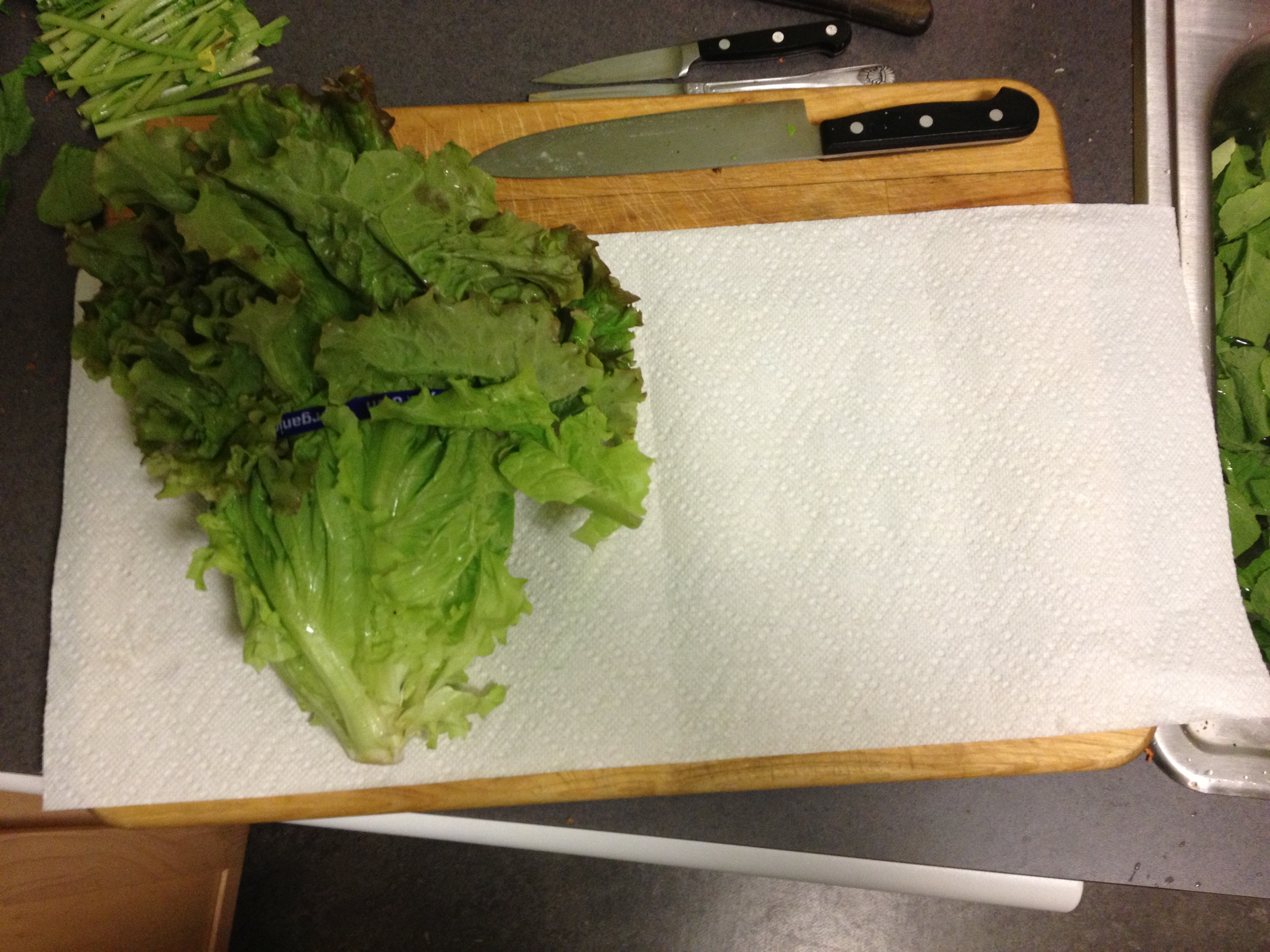
Lay the veg out on a clean, dry paper towel. If the greens are visibly dirty, spray off the dirt, but don't leave too much water clinging to the veg.

Lay the veg out on a clean, dry paper towel. If the greens are visibly dirty, rinse away the dirt, but don’t leave too much water clinging to the veg.
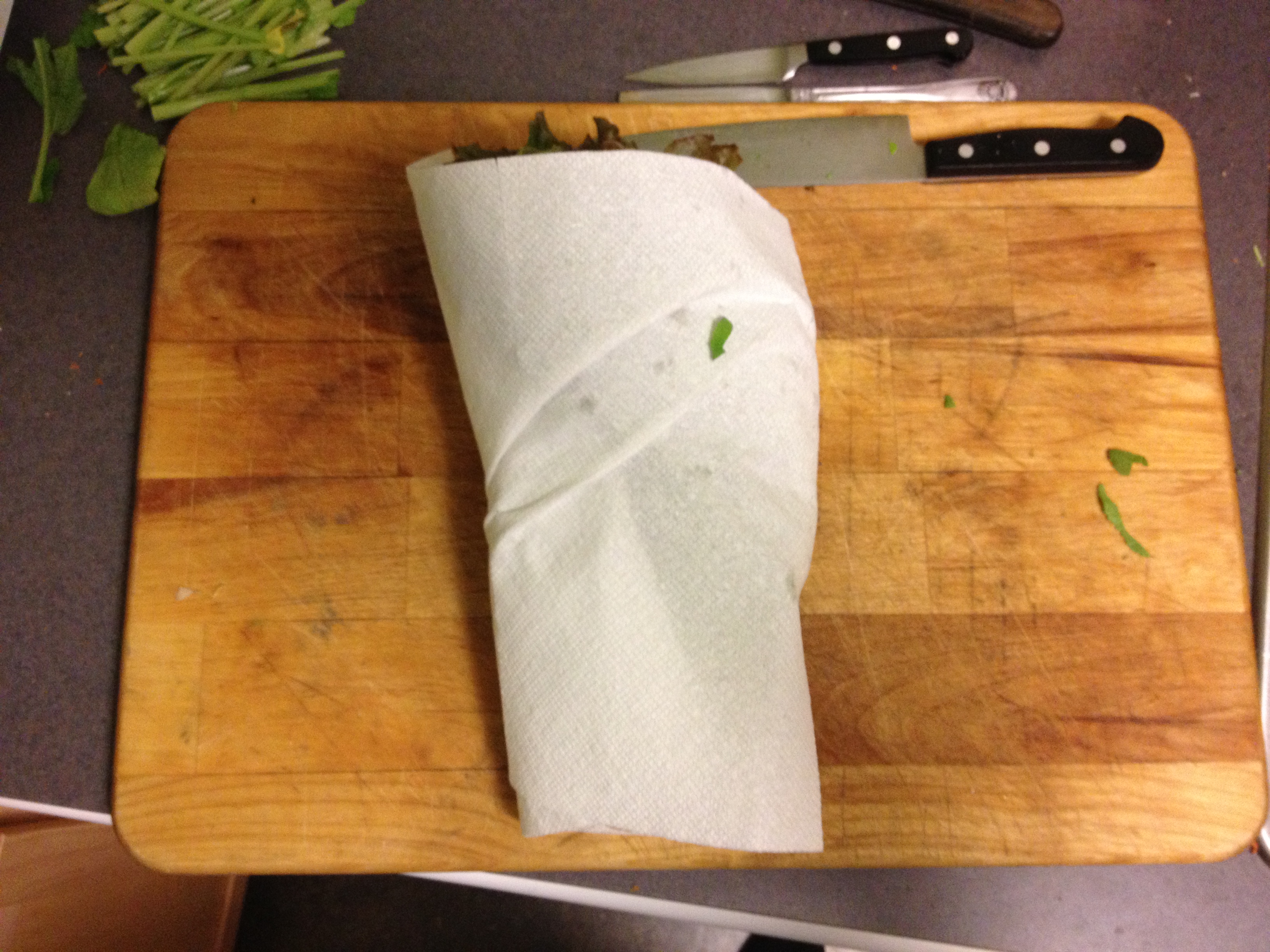
Just like a tiny infant, bring all of the leaves together and tightly wrap in the paper towel.
Bring all of the leaves together and tightly wrap in the paper towel.

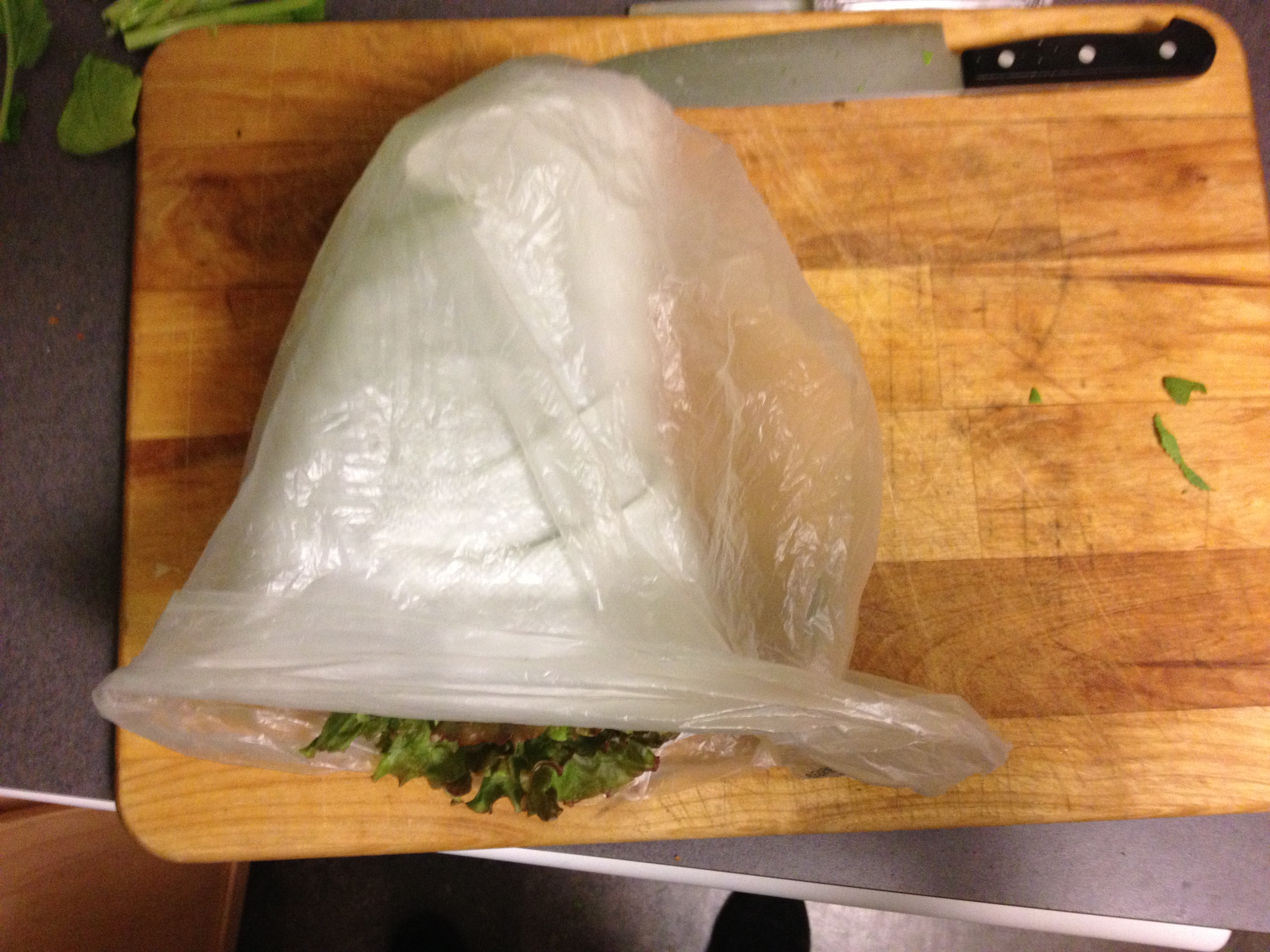
Put the paper towel-wrapped veg into a plastic bag. Twist the top closed.
Put the paper towel-wrapped veg into a plastic bag. Twist the top closed.


3 Comments

White beans and escarole with pasta.

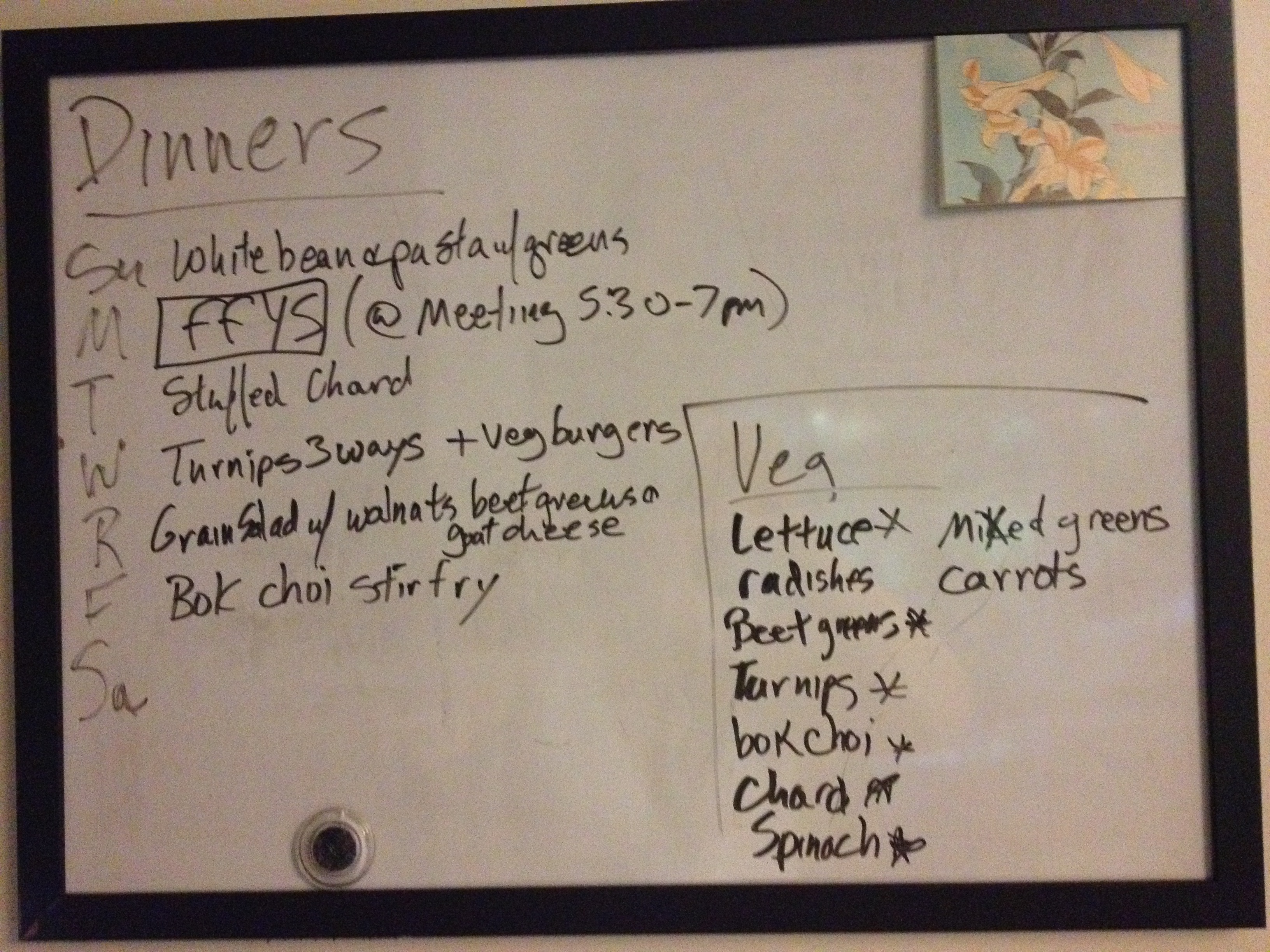
The dinner board lists the veg on hand and the dinners we’ll make with it (I hope). I star the veg that’s going to be used in a specific recipe. FFYS means “fend for yourself”-and means that neither of us are availble to cook that night.

Each week, I strive to look over our store of vegetables and draw up a menu for our dinners. It helps me to focus my grocery and farmer’s market purchases, plus, as I’m walking home from work, I can go over the plans for dinner and be ready to prep when I walk in the door (or after Pidi and I get home from the Dog Park.) As you can see from the board, Sunday night’s dinner was supposed to be “white ends & pasta w/greens” and since it’s Sam’s day off work, he was planning on cooking. He asked me for the recipe, but I realized I had never written this recipe down anywhere. I put pen to paper (figuratively), so Sam didn’t have to develop his psychic abilities to cook recipes that I’ve made up and never written down…

Frisee-style Escarole (via OneDropDream) Escarole (Via InMyBox.Wordpress.com)
Escarole is a fleshy lettuce with a mild, bitter taste and is very similar (indistinguishable, I think) from endive. Sometimes, sadistic farmers grow “chicories,” blanched plants that are forced to grow into tight pointed heads. All of these veg – escarole, endive, chicories – are part of the family of Italian cooking greens. For people who don’t like cooked lettuce, think of fleshy Italian cooking greens more like spinach or kale – greens that we cook without batting an eyelash – instead of like lettuce.

Not knowing what to do with escarole, a few years ago, I turned to Farmer John’s The Real Dirt on Vegetables that recommended cooking escarole with pasta in olive oil with garlic, and to Alice Waters who has a recipe for greens and white beans in her Chez Panisse Vegetables cookbook (repo@Serious Eats). I combined the two – because who doesn’t like beans and pasta?

White beans and escarole with pasta

  • 1 head of escarole (see the picture above for sizing)
  • 14.5 oz can of small white beans, great northern beans, white kidney beans or cannelloni*
  • 1 pound small pasta that cook up to be about the same size as a bean**
  • 3-4 garlic scapes
  • olive oil
  • salt and pepper
  • 1/4 cup heavy cream (optional)
  • Shaved parmesan (optional)

*I’ve tried this with dried beans, and you need the thick bean broth from the canned beans to form the basis of the sauce. Don’t try it with dried beans.

**Ditalini is the perfect pasta for this dish since it cooks up to the same size as a bean, but it’s hard to find.  Alternatives are rotini, penne, cut spaghetti or elbow macaroni.

Prep

  1. Wash and dry the escarole and chop or tear it into 2″ pieces. Taste the core and make sure it’s not terribly bitter before including it.
  2. Mince the garlic scapes, omitting the tip of the scape, if dry, and the neck where the scape bulbs into a spade shape.

Cook

  1. Boil water with salt, and cook the pasta until al dente.
  2. While the pasta cooks, heat 1-2 tbsp olive oil in a large skillet over medium heat.
  3. Add the scapes and cook for a minute until they’re soft.
  4. Add the escarole and turn in the olive oil to wilt. If it won’t all fit in the pan (often it doesn’t…) steam the greens by adding all of the escarole to the pan and 2 tbsp water. When it steams, cover the pan for 1-2 minutes until the escarole has wilted and is more manageable. Turn the escarole in the oil to mix around the flavor.
  5. Open the can of beans and pour the whole can, bean sauce and all, into the skillet. Bring the beans and greens to a simmer. Reduce the heat to low and cook until the pasta is done.
  6. Before draining the pasta, reserve a cup of the cooking liquid. This will CYA if there isn’t enough bean juice to coat the pasta and you have to thin it out a little bit.
  7. If the skillet will hold it, add the pasta into the skillet and cook for another minute or two. Otherwise, return the pasta to the pot, and use the heat of the pot to dry off the extra moisture. Add the contents of the skillet and mix. If there’s not enough sauce, thin it out a bit with the reserved cooking liquid.
  8. Taste and adjust the salt and pepper. If you like the dairy thing (this recipe is vegan up until this point), take the pan off the heat and stir in cream.
  9. Top with shaved parmesan, if you like the dairy thing… Parmesan is salty, so don’t over-salt the dish.


1 Comment

Stuffed Chard

A few years ago, I tried to make sushi using chard leaves instead of nori. It was a complete failure, but what emerged was this recipe for stuffed chard.

Stuffed Chard

This recipe makes 8 chard rolls  (4 servings) stuffed with creamy rice.

  • 8 large (about a foot long) pieces of Swiss chard with stems and leaves
  • 8 slices of ham
  • 8 slices of provolone cheese
  • 4 cups cooked rice
  • 4 tender aromatics (ramps, green onions or green garlic)
  • 4 tbsp butter
  • 1/4 cup cream
  • Salt and Pepper
  • 1/2 cup dry white wine

Cook the rice – You’ll have to look elsewhere for directions because I use my rice cooker.

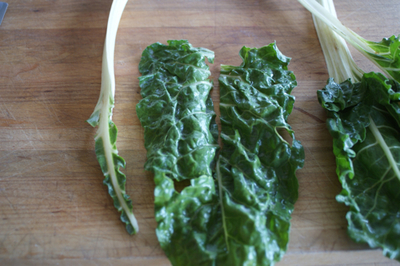
Prepare the vegetables. Wash the chard well and dry in the salad spinner. Lay each piece on the cutting board and make a V shaped cut to remove the stem (See picture). Dice the stems. Set the leaves aside. Similarly, wash and dry the aromatics, and dice the leaves and stems.

Melt 2 tbsp butter in a small skillet or saucepot over medium heat. Sauteé the chard stems and aromatics until soft.

Off the heat, add rice to the sauteed greens, along with an additional 2 tbsp butter and cream. Mix well using a folding motion (to not break the rice grains) until the rice absorbs the additional fat and moisture. The rice should stick together, not be separate grains. (Think sushi rice, rather than Uncle Ben’s.) Add pepper and salt. Don’t skimp on the salt or else the rice will taste boring.

Assemble the Stuffed Chard:

If your chard is very fresh and crisp, like in the picture above, microwave each leaf for 5 to 10 seconds to soften it and make it easier to roll.

Lay the chard leaf on your work surface and close the hole from the stem by crossing over the two “lobes” that were on either side of the stem.  Lay a slice of provolone centered on the leaf. Lay a slice of ham centered on the chard leaf. Using an ice cream scoop, #6 disher or 1/2 cup measure, mound 1/2 cup of rice on the center of the provolone. Starting with the chard, gently roll the chard, ham and provolone around the rice. Add to a 9×9″ glass baking dish with the seam side down. If the roll is wider than about 5″, tuck the ends into the rice.

Repeat these rolls, arranging them 2 across in 4 rows in the glass baking dish. Add 1/2 cup white wine to the baking dish. You can add 2 tbsp melted butter if you’re not watching calories. Cover with plastic wrap. Microwave for 8 minutes on high, then for 8 minutes on 50% power.

Optional: If you really like cheese, take the dish out of the microwave, top with cheese and broil it (6″ from the broiler) for 5 minutes until the cheese is melted and browning.

Serve two rolls per serving, topping with liquid from the bottom of the dish as a sauce.


6 Comments

Rhubarb? No, YOU barb!

How many variants of this picture have I posted to this blog? Egads...

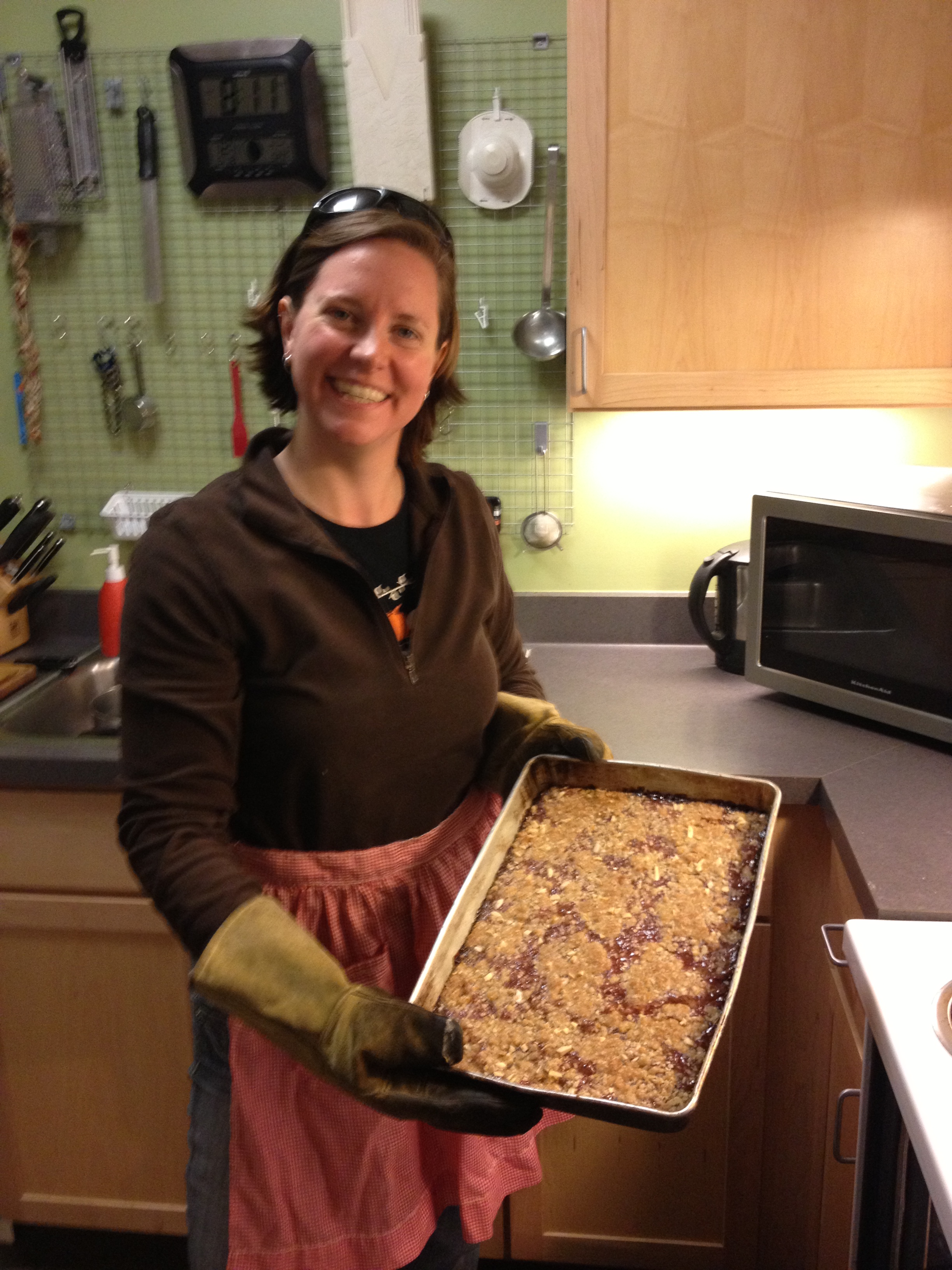
The writer with her rhubarb bars. How many variants of this picture have I posted to this blog? Egads…

Rhubarb was in season at the farmers market for two dollars a pound. I decided to pick some up and make my annual Sisyphean attempt to make good rhubarb bars.
For those of y’all who aren’t from the upper midwest, a bar is as midwestern as hot dish. (as a sidenote, I’m dictating this blog post using iOS voice recognition software. Hot dish came out as “hot bitch.” ) Bars are a baked good, not a cake, made in a rectangular pan and cut into squares. For example, brownies are a subtype of a bar. Midwestern social functions rarely feature cupcakes or cookies, since bars are easier to transport and can be cut on site. Sam rightfully points out that bars have the individual serving and easy finger-eating like cookies, but are easy to make like a cake.
So that explains the “bars” part – do I need to explain rhubarb? Rhubarb is the stalk of a toxic and poisonous plant used historically as a laxative. However, when the stems are pink, they have a VERY TART taste that can be cooked with sugar to tame the sweetness and denature the toxins that would upset your stomach. I’ve eaten raw rhubarb only once, and I still regret it. It tastes more tart and bitter than a lemon. Think celery mated with lemons and lye. We still eat it because rhubarb is a perennial that grows early in the year when most other vegetables still resemble salad.

This will be the fourth time- if not the fifth – that I tried making rhubarb bars. I think they haven’t ever turned out well except for the first time, but Sam thinks that they’re good. He’s biased. I can steal his heart through his stomach. Rhubarb bars are basically rhubarb jam sandwiched in between a crumble. You make the crumbly stuff with oats, butter and nuts,  press a bunch of it into the bottom of the pan, dump the jam on top, and sprinkle the last of the crumble on top of the jam (see photo illustration). The bars bake in the oven and hopefully come together as a coherent sandwich of oaty goodness and jam. Problem is, if you get the water balance wrong, they don’t turn into coherent bar things they become crumbly mess things.

Sam gently mixes the crumble... but not too much.

Sam gently mixes the crumble… but not too much.

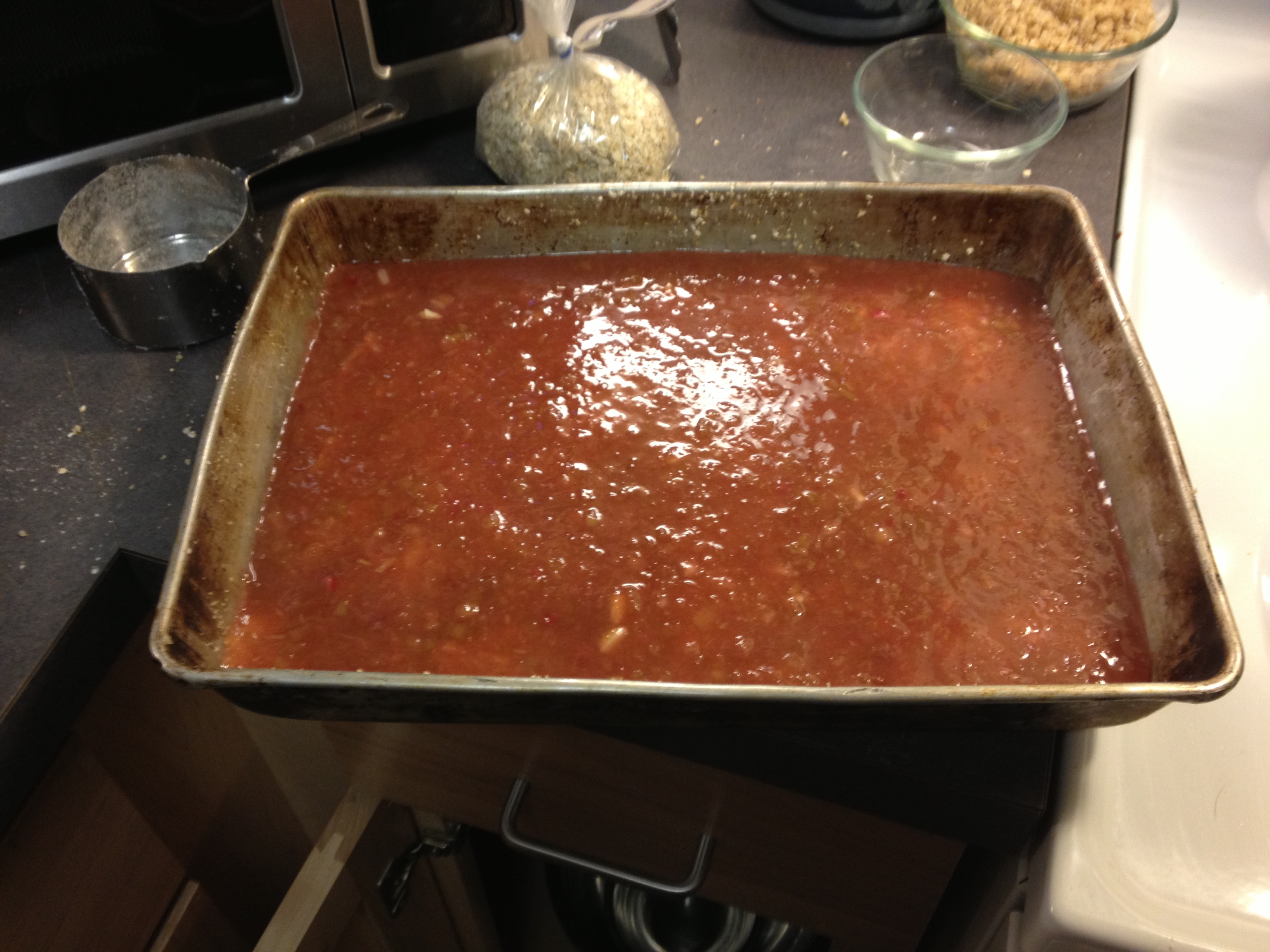
Rhubarb jam - chopped rhubarb, sugar, a little water and flour to thicken.

Rhubarb jam – chopped rhubarb, sugar, a little water and flour to thicken.

The jam gets dumped on top of the crumb.

The jam gets dumped on top of the crumb.

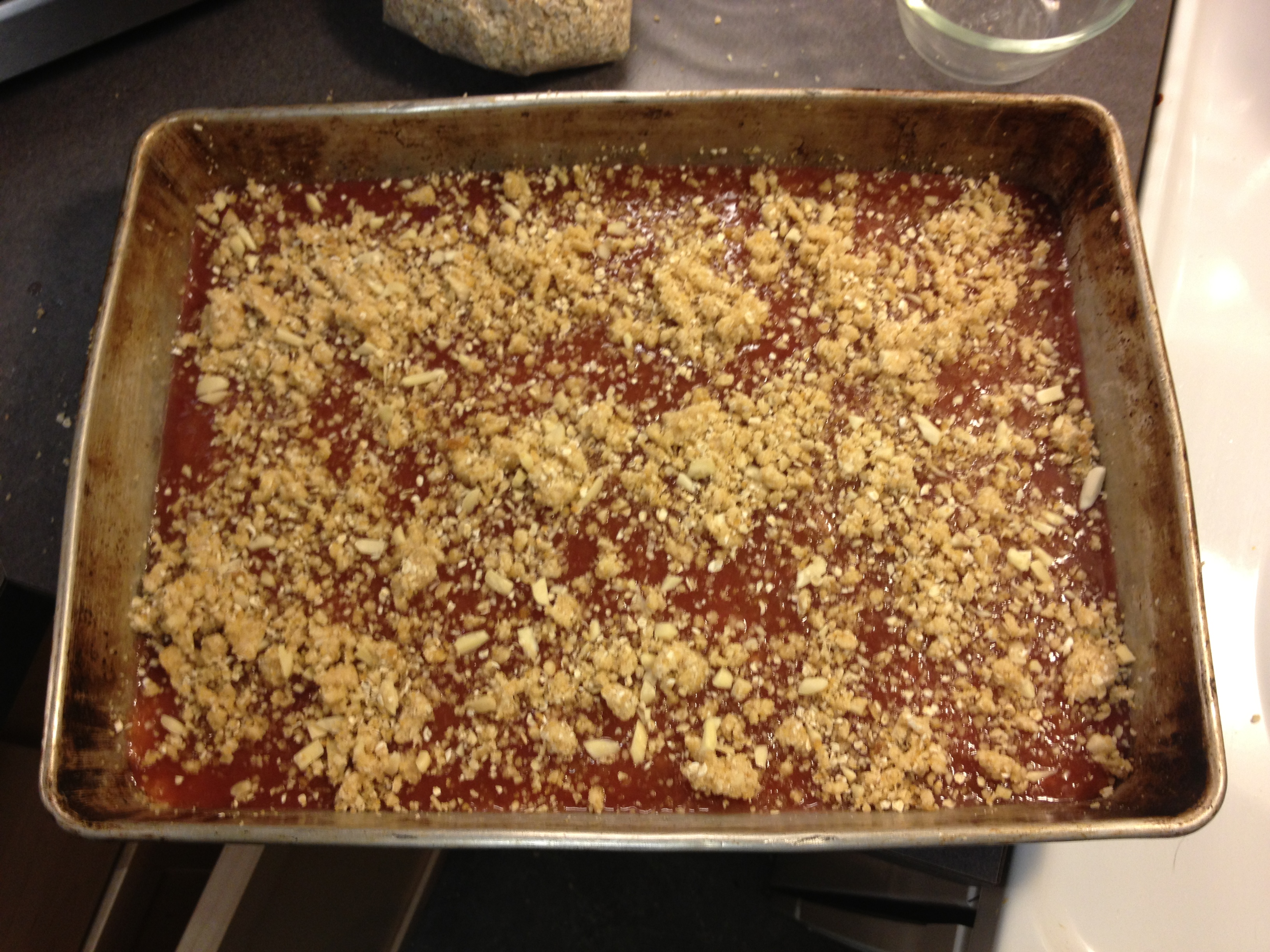
A little crumb is sprinkled on top of the jam, thus completing the sandwich.

A little crumb is sprinkled on top of the jam, thus completing the sandwich.

Sam helped to make the crumble. This was a big risk, but I knew he could handle it. This is because Sam is inflicted with MHT or Male Homogenization Tendency. (It’s in the DSM V – Look it up…)  This is the tendency for men, when asked to combine ingredients, will incorporate them to their most homogenous state. This is, of course, the antithesis of crumble which is supposed to be butter and crumbs and not a paste. Sam handled the responsibility admirably, and kept his MHT in check the entire time. We got crumble as opposed to pastry. (Don’t get the mistaken impression that MHT is always a bad thing. Sam creams butter and sugar like nobody’s business.)
Typically I use Barb Perkins’s recipe from the Vermont Valley farm website, but this year I tried a variant of that recipe from Midwest living. The jam was much thinner more liquidy and there was a lot more of it. It was easy to spread over top of the crumble. I used slivered almonds instead of walnuts or pecans, as the recipe called for, because they were on sale at the co-op.
All and all, the bars turned out OK. Pretty good, actually. I’m glad I left the almonds fairly large, as they added a good crunch to the bar. Not too crumbly, either. I may have found a rhubarb bar recipe that I could get behind.


Leave a comment

Christmas Cookbooks: from Cooks Illustrated…

An illustration of pig anatomy and pork primals from the Science of Good Cooking from Cooks Illustrated Press, 2012.

An illustration of pig anatomy and pork primals from the Science of Good Cooking from Cooks Illustrated Press, 2012.

As I mentioned in yesterday’s post, I got a lot of cookbooks for Christmas. Today, I’m going to review the three cookbooks that I got from Cooks Illustrated. Two books are hardbound annuals, and the other is a new cookbook based on techniques.

The hard bound annual editions are like the hard bound journals in academic libraries… Take all of the paper monthly journals for the year and slap them between two hard covers. I have been amassing these annual editions since I became a Cooks Illustrated subscriber in 2005. This year, Sam gave me the 2001 and 2009 editions. 2001 was working back in the timeline, and for some reason, I never got the 2009 edition.

Illustration of moisture expelled from roasts after variable minutes of resting.

Illustration of moisture expelled from roasts after variable minutes of resting.

The cookbook The Science of Good Cooking is a collection of recipes and techniques arranged around a common scientific/cooking/chemistry concept. Each section describes the science behind the concept, illustrates how the concept works in cooking using laboratory-like experiments, and then presents recipes that utilize the concept. For example, concept #3 is “Resting Meat Maximizes Juiciness.” In this chapter, the concept is presented as resting meat reabsorbs expelled water back into muscle fibers. Then they test the concept by resting equal-weight roasts for different amounts of time (0 to 40 minutes) then measuring the amount of liquid expelled after slicing. Then they include a table summarizing the amount of time to rest meats, based on similar tests. Then there are recipes using the resting technique to increase moistness: grilled flank steak and pork roast.

Bibliography

The Editors at America’s Test Kitchen and Crosby, G. The Science of Good Cooking. 1st ed. Brookline, MA: America’s Test Kitchen; 2012. ISBN: 978-1-933615-98-1. Details at CooksIllustrated.com.

The Editors of Cooks Illustrated. Cooks Illustrated. 2001 Bound Annual Ed. Brookline, MA: Boston Common Press LLP; 2001. ISBN: 0-936184-56-6. Details at CooksIllustrated.com.

The Editors of Cooks Illustrated. Cooks Illustrated. 2009 Bound Annual Ed. Brookline, MA: America’s Test Kitchen Press; 2009. ISBN: 1-933615-49-4. Details at CooksIllustrated.com.


Leave a comment

Christmas Cookbooks: How to Cook Everything (The Red Book)

Four cookbooks. Cooks Illustrated Bound Annuals from 2001 and 2009. The Science of Good Cooking from Cooks Illustrated, 2012. How to Cook Everything (The Red Book) by Mark Bittman, 2008.

Four cookbooks. Cooks Illustrated Bound Annuals from 2001 and 2009. The Science of Good Cooking from Cooks Illustrated, 2012. How to Cook Everything (The Red Book) by Mark Bittman, 2008.

I made out like a bandit this Christmas for Cookbooks. Thanks to my husband, Sam and to my Mom for these most excellent reference books. I want to describe these books a little bit and give you a flavor of how I expect them to be useful in the future.

How to butterfly a chicken. Illustrations from How to Cook Everything (the Red Book) by Mark Bittman, 2008. Illustrations by Alan Witschonke.

How to butterfly a chicken. From How to Cook Everything (the Red Book) by Mark Bittman, 2008. Illustrations by Alan Witschonke.

Bittman’s book, How to Cook Everything – I call it the Red Book – is the modern version of the original Fannie Farmer Boston Cooking School cookbook or the Betty Crocker cookbook. It’s the one book that a cook needs in order to make most every basic recipe. Bittman incorporates the international cooking style that has come to be known as “American” cooking – a little French, a little Italian, a little Asian, a little Middle-eastern, and a lot of reliance on equipment and seasonings. Bittman also gives ample space to specific techniques – Illustrated by Alan Witschonke in pen and ink. There’s none of the “food porn” photography. Not too many “weird” parts of animals. Not too many pointless variants on the same recipe. He avoids specialty ingredients like black garlic, san marzano tomatoes, etc, that clutter up recipes from famous Restaurant chefs. Want to make waffles? There’s a recipe. Want to cook black beans? There’s a recipe. Want to know how done to cook a chicken thigh? There’s a table. Want to know the correct ratio of fat to flour in a pie dough? Look it up. (although Barahm’s The Science of Cooking and Ruhlman’s Ratio to a better job). Just like Julia Child’s Mastering the Art of French Cooking, this cookbook will be a “sticky note” cookbook – meaning there are specific recipes that I frequently turn to as staples of my cookery.

Screen shot from the How to Cook Everything (The Red Book) for iPhone.

Screen shot from the How to Cook Everything (The Red Book) for iPhone.

I originally found the Red Book by necessity. On my shelf I have one “generic” cookbook – Fanny Farmer’s Boston School Cookbook – and I find myself turning there (and to general internet searches) to find recipes for making “basic” stuff that I can’t just make up without a recipe. For example, I can bake an apple crumble without a recipe, just as long as I can remember the ratio of butter::nuts::oats::flour::sugar that goes into the topping. I don’t have any intuitive sense for how much water to use when cooking beans or grains, so I have to look it up each time. To me, it doesn’t matter what type of nuts or what type of sugar, what type of bean, or how much water… I just need a sense of how much to put together. Fanny Farmer is good for older types of cooking, like pie dough and sweet and sour cabbage, but is very lacking in newer American food trends. I had no idea how to make hummus… Fanny Farmer didn’t tell me much of anything and the internet was saturated with bad, unreliable and untested recipes. (I hate 99% of internet recipes… but that’s another tale… )I needed a cookbook that had recipes for basic but more modern foodstuffs.

I had been introduced to the Red Book a few years ago when learning how to poach an egg. Bittman gives plenty of time for technique on this basic “recipe” – add vinegar to the simmering water, crack the egg onto a plate to ease transition into the water, swirl the water to create a vortex for the egg, spoon water over the yolk to set it, trim off the threads. Does it count as a recipe when the ingredients are an egg, a splash of vinegar and water? Here the Red Book shines with excellent technique.

So, to sum up the Red Book: It’s a basic cookbook with good techniques and basic recipes for standard dishes. Everything is very practical. The recipes are well-tested and are reliable.

Bibliography

Bittman M. How to Cook Everything: 2,000 simple recipes for great food. Tenth Anniv. Ed. Hoboken, NJ: John Wiley & Sons, Inc; 2008. ISBN: 978-0-7645-7865-6.


Leave a comment

This Week in Breakfast: Cafe Metro

So our options for breakfast places are dwindling. The few remaining places on our list are either too far away, too expensive, or just coffee shops that happen to be open on Sundays. We’ll visit the too far away places when Sam and I get a Sunday where he doesn’t have to be at work too early. However, now that Whaleback is open for the season, our Sunday breakfasts are more time constrained. The too expensive places we’re saving for when friends or family come to visit us – nudge. nudge.

I’ve been procrastinating posting about Cafe Metro, our breakfast spot from Sunday, December 16, because that was the start of Mushroom week – there were better things to be posting about than breakfast at a coffee shop.

Cafe Metro used to be the Bagel Basement and was previously the go-to place for hungover undergrads on Saturday and Sunday mornings. Although we encountered some undergrads, I wasn’t sure they were hungover. Plus, we were at breakfast on Sunday at 9am. Isn’t that a bit early for most undergrads? Most of the complaints about Bagel Basement (see the linked article) seem to have been mitigated – the place is clean, well-stocked and has bagels and pastries, plus a few extra weekend breakfast items.

I had a breakfast burrito with chorizo and eggs. I was anticipating greasy and red chorizo sausage. What I got was mildly spiced pork sausage. It was tasty, but not what I was expecting. Sam had a bagel with lox and cream cheese. We also shared a monkey bread, which is like a cinnamon roll, but cut up into pieces and served in a muffin paper. The dough was yeasted and very tender.


Christmas Cookies

1 Comment

This year I didn’t go wild with the Christmas cookies. Frankly, we don’t know enough people here to offload so many cookies!

This gallery contains 4 photos