ReLocavore: Redefining "local"

Back to Wisconsin, my cheesehead friends


Leave a comment

Mushroom Week: Common Edible Mushrooms

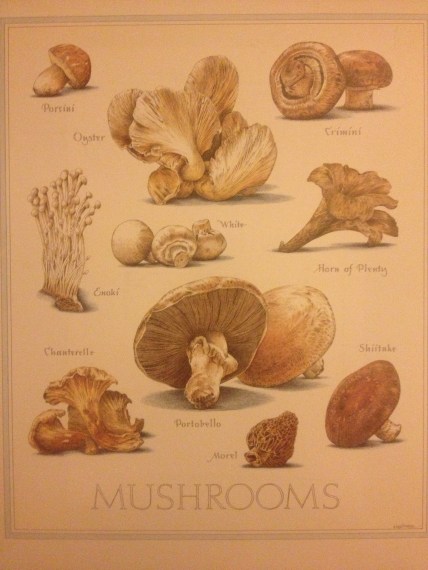
This is a mushroom poster we have framed on our wall. It is from the back cover of Cooks Illustrated Magazine.

This is a mushroom poster we have framed on our wall. It is from the back cover of Cooks Illustrated Magazine.

I have eaten the following mushrooms:

  • Basic white button mushrooms. They come fresh and canned. I love to add them to my chili.
  • Crimini. Little portobello mushrooms. A good all-purpose mushroom. When I make mushroom pate, I only use crimini.
  • Portobellos. Big portobellos. 3-5″ cap and a thick stem.
  • Puffballs. These are BIG 12″ spherical, white mushrooms that grow wild. If you can get them when they’re very white, they cook up like scrambled eggs.
  • Morels. A rare treat for the early spring. Nobody seems to have figured out how to grow them commercially, so the best place to get them is at farmer’s markets. They’re funny-looking and go GREAT with brown butter.
  • Porcini. I’ve never had these mushrooms fresh, only dried. They have a wonderful woodsy scent.
  • Shiitake. A japanese mushroom with a wide, thin cap and a narrow stem. I have had them both fresh and dried.
  • Enoke. Another japanese mushroom that comes in bunches. It’s mostly stem with just a little tiny cap.


Leave a comment

Mushroom Week Day 3: Mushroom Risotto

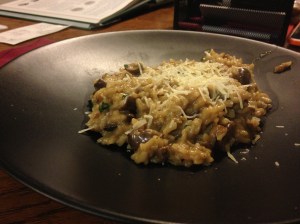
Mushroom Risotto (Cooks Illustrated Sept/Oct 2003)

Mushroom Risotto. Tastes better than it looks. Srsly. (Cooks Illustrated Sept/Oct 2003)
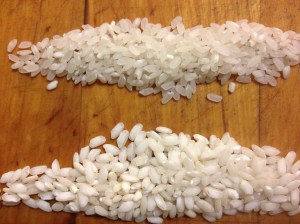
Arborio rice on the bottom. Japonica rice on the top. The arborio is whiter because it has more starch and less protein. Note that the shape is even stumpier than Japonica. (Japonica or "sushi rice" is basic Japanese short-grain rice.) Arborio rice on the bottom. Japonica rice on the top. The arborio is whiter because it has more starch and less protein. Note that the shape is even stumpier than Japonica. (Japonica or “sushi rice” is basic Japanese short-grain rice.)

Risotto is fancy Italian garbage rice. In general, risotto is made by toasting rice in butter, then cooking the rice slowly with little infusions of flavorful liquid while stirring, and stirring and stirring and stirring and stirring and stirring and stirring and stirring and stirring and stirring and stirring and stirring and stirring and stirring and stirring, then add butter or cheese. Voila!

The key to risotto is the special arborio rice. The grains have two unique characteristics: they’re high in starch and shaped more like a football than a sausage. Because the arborio rice grains are stumpy, football-shapes, they are less likely to break while stirring and stirring and stirring and stirring and stirring and stirring and stirring. Since the grains have lots of starch, all of that stirring rubs the starch grains against each other, sloughing off starch on the outer layer of the cooking grain and mixing it into the interstitial cooking space, making the risotto creamy.

We didn’t just have risotto for dinner, we had mushroom risotto. Again, this is a Cooks Illustrated Recipe (Sept/Oct 2003). To get lots of mushroom flavor the recipe has two important elements. One, like yesterday’s mushroom ragu, the recipe uses rehydrated porcini mushrooms and their broth. Second, the recipe adds soy sauce, which has lots of “brown” or umami flavors. So, in the risotto is 1 oz reconstituted porcini mushrooms (about 1 cup when rehydrated and minced) plus the caps of crimini mushrooms, cut into quarters instead of slices, so they hold together during cooking. The dish is finished with salty parmesan cheese, some parsley for color, and a bit of butter. Took about an hour to prep and cook.


Leave a comment

Mushroom Week: Mushroom Nutrition

Nutrition for 8oz of white button mushrooms.

Nutrition for 8oz of white button mushrooms.

Once I had figured out basics of Mushroom biology, I wanted to know what are they made of? Are they meat or vegetables? How much protein and fiber do they contain?

The main stuff that makes up mushrooms is a protein called chitin. It’s a protein that is also found in insect exoskeletons. Hmm… There’s also other nutrients that occur in small amounts and vary according to th e

I looked up mushroom nutrition in the USDA nutrition database. It seems there’s not much of anything in mushrooms. Based on plan-old white button mushrooms, an 8 oz serving (about a packed cup of chopped mushrooms… or three portobello caps. A lot of mushroom) is only 50 calories. Most of the nutrition is from fiber (2.3 g) and protein (7.0g). Compare this to 8oz of flank steak (lean beef) has 440 calories, mostly fat (18.9g) and protein (63.5 g). Really, mushrooms are a fibrous network to hold water.


1 Comment

Mushroom Week: Day 2 Mushroom Ragu

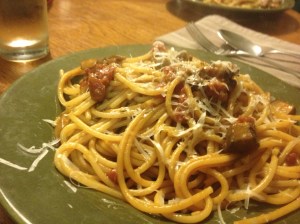
Mushroom Ragu. Fan-stupid-tastic.

Mushroom Ragu. Fan-stupid-tastic.

Of all of the recipes I have ever cooked, this is the best. There have been recipes that are easier (mapo tofu), that I make more frequently (pasta primavera), that I save for special occasions (tonkatsu), or that I work hard to enjoy the indulgence (e.g. calzones). This recipe tastes the best, cooks the fastest, and is the most reliable. The whole impetus of Mushroom week was the mushroom and wild rice soup from last night, plus my LOVE for this recipe. I hope everyone tries it out.

You’ll find porcini mushrooms at high-end grocery stores, the internet or mail-order. Give them a smell, if you can get into the packaging. They should smell strong of earth and woods.

This is also another recipe that would be easy to convert to vegetarian or vegan. Substitute chicken broth for mushroom or vegetable broth (or water…) and either omit the pancetta or substitute some other faux-meat. If you do omit the pancetta, add extra olive oil (a tablespoon maybe?) and cook the tomato paste (step 2) until it is very brown, but not burnt. This will make sure there are lots of interesting maillard reactions to produce meaty flavors. You’ll be happy to give it the extra minute or two.

I want to emphasize how important it is to rinse and strain the porcini mushrooms. They come dried and there’s always some grit in the dried mushroom. This recipe reconstitutes the mushrooms in chicken broth to form tasty mushrooms, and a VERY rich flavorful broth. It may seem unnecessary to pick the mushrooms out of the broth with a pair of forks, or to filter the broth through a coffee filter, but DO IT. These steps make sure there is no grit left in the mushrooms or the broth. Grit will RUIN this recipe.

The first time I made this recipe, I totally skimped on the de-gritting of the porcini. I just dumped the mushrooms through a wire strainer over a measuring cup, transferring all of the grit into my recipe. It was not good, let me tell you…

Mushroom Ragu

Serves 4
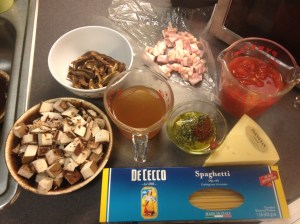
Mise en place for Mushroom ragu. From top left: porcini mushrooms, pancetta, crushed tomatoes, parmesan cheese, spaghetti, portobellos, chicken broth and a bowl holding the olive oil, garlic, rosemary and tomato paste.

Mise en place for Mushroom ragu. From top left: porcini mushrooms, pancetta, crushed tomatoes, parmesan cheese, spaghetti, portobellos, chicken broth and a bowl holding the olive oil, garlic, rosemary and tomato paste.

1 oz dried porcini mushrooms, rinsed well
1 cup low-sodium chicken broth
4 oz pancetta, cut into 1/2″ pieces (substitute country ham or thick-cut bacon just fine. Don’t substitute proscuttio.)
1/2 pound (2 large) portobello mushrooms, stems and gills removed, but into 1/2″ pieces.
3 tablespoons extra-virgin olive oil
4 medium garlic cloves, sliced thin
1 tablespoon tomato paste
2 teaspoons minced fresh rosemary leaves (we used dried)
14.5 oz can of whole tomatoes
salt and pepper
1 pound spaghetti
grated pecorino Romano cheese (I substituted parmesan because I needed parmesan for another recipe I’m cooking later this week.)

1.  Place porcini and broth in a small microwave-safe bowl; cover with plastic wrap and cut several steam vents in plastic with paring knife.  Microwave on high power 1 minute, until broth is steaming.  Let stand until mushrooms soften, about 10 minutes.  Lift mushrooms from broth with fork and finely chop.  Strain broth through fine mesh strainer lined with a large coffee filter into medium bowl.  Set aside mushrooms and broth.

2.  Heat pancetta in 12-inch skillet over medium heat; cook, stirring occasionally, until rendered and crisp, 7 to 10 minutes.  Add portobellos, chopped porcini, olive oil, garlic, tomato paste, and rosemary; cook, stirring occasionally, until all liquid has evaporated and tomato paste starts to brown, 5 to 7 minutes.  Add reserved chicken broth, crushed tomatoes, and their juices; increase heat to high and bring to simmer.  Reduce heat to medium-low and simmer until thickened, 15 to 20 minutes.  Season with salt and pepper to taste.

3.  While sauce simmers, bring 4 quarts water to boil in a large dutch oven.  Add 1 tablespoon salt and pasta; cook until al dente.  Drain pasta, reserving 1/2 cup cooking water, and return to pot.  Add sauce to pasta and toss to combine.  Adjust consistency with reserved pasta water and season with salt and pepper to taste.  Serve, passing pecorino separately.

Per Serving (with no added cheese):
Calories: 641
Total Fat: 25.1 g
Sodium: 715 mg
Carbs: 74.3g
Protein: 28.4g

Leave a comment

Mushroom Week: Mushroom Biology

In the taxonomic world of living things, there are 5 kingdoms: animals, plants, fungi, protists (called eukaryotes when I was in school), and prokaryotes. Mushrooms are fungi – an entire KINGDOM of foods to discover and eat! We are very familiar with yeasts and their culinary properties – yeasts are single-celled organisms that eat sugar, belch gasses, and make bread and beer. Molds are another type of fungi – think blue cheese, penicillin and shower curtains. Mushrooms are only one part of the remaining kingdom of fungi.

The thing we thing of as the “mushroom” is often the “fruiting body” of a vast structure that makes up the entire fungus. The mushroom part comes together, raises up out of the ground and releases spores – part of the way the mushroom can reproduce. We are not going to discuss how this type of reproduction relates to human reproduction, or else I’ll get the giggles…

So the mushroom often has “gills” where the spores are kept. The gills provide lots of surface area to distribute the spores. In my opinion, gills get in the way of culinary goodnesss, so I often scrape them out, especially in big portobello mushroom caps.

The big difference between fungi and other organisms is that fungi break down other organisms for their own nutrition. Animals eat plants and other animals. Plants get energy from soil, water and sunlight. Fungi eat everything, breaking down dead material into it’s basic components, then rebuilding it to feed themselves. It’s kind of like Minecraft… Except with fewer Creepers.


Leave a comment

Mushroom Week Day 1. Wild Rice Mushroom Soup

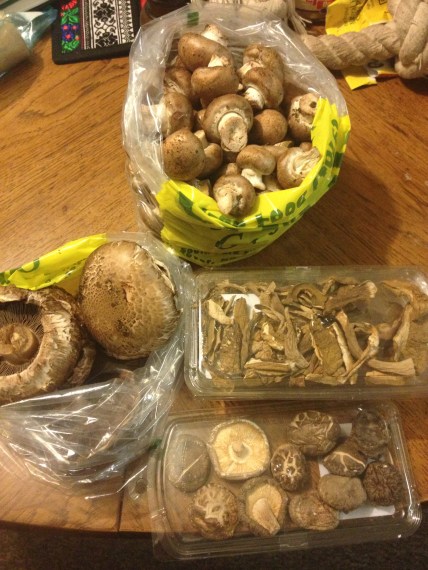
The mushrooms for this week's recipes. 2.5 lbs crimini. 2.0 lbs portobello. 0.5lbs dried porcini. and 0.1 oz dried shiitake.

The mushrooms for this week’s recipes. 2.5 lbs crimini. 2.0 lbs portobello. 0.5lbs dried porcini. and 0.1 oz dried shiitake.

This has (somehow) become mushroom week. In the most recent (January/February 2013) Cooks Illustrated, there was a recipe for Wild Rice and Mushroom Soup. It looked good, so I thought to make it for dinner one day this week. Somehow, this spiraled into an entire weeks’ worth of mushroom recipes.

I also want to learn a little more about mushrooms. I eat them occasionally, but not regularly. There is much to explore.

The first recipe of the week is for Mushroom and Wild Rice Soup. If you would like a copy of the recipe, please email me. I’m hesitant to post it to my site because it’s copyright from Cooks Illustrated. I wouldn’t want to get into trouble.

The recipe has two interesting twists. First, the wild rice is cooked with baking soda to keep the grains intact. Didn’t make much of a difference, as far as I could see. Our grains fell apart. However, I am a cheapskate, so I didn’t buy the $25.99/lb “whole” wild rice, but the $6.99/lb “broken” wild rice. Might have something to do with it. Second, they use powdered shiitake mushrooms and cornstarch to give the broth some thickness and body. The broth did have thickness and body. Success!

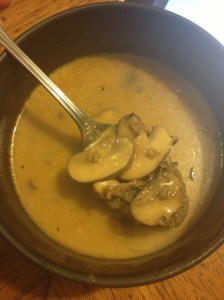
Wild rice and mushroom soup. I had to work really hard to make it look tasty. Mushrooms and wild rice tend to sink.

Wild rice and mushroom soup. I had to work really hard to make it look tasty. Mushrooms and wild rice tend to sink.

We made one main modification – I don’t eat a lot of dairy, and the recipe called for adding 1/2 c heavy cream at the end of cooking. This would be way too much cream for me – so we substituted coconut based nondairy creamer. It’s not sweet and the soup didn’t come out tasting like coconut.

I keep saying “we” like I had anything to do with the cooking. Sam did all of it. All of the prep, all of the stirring. Everything. I was in my office stuffing Holiday cards into envelopes through the whole thing. I did stop by the kitchen to refill my glass of wine and observe the progress.  Tomorrow will be different. We’re making one of my favorite recipes… More then.


Leave a comment

Subarus and the Northeast.

I’m reading Randall Rothenburg’s Where Suckers Moon: An advertising story. In the book, he followed executives from Subaru of America while they searched for a new advertising agency in 1990, found their new agency, Wieden + Kennedy, and eventually divorced their agency.  At the time that Rothenburg was writing, the most Subarus were sold in the Northeast and in Washington, Oregon, and Colorado, with almost no sales in the Midwest, California, Arizona and the South. I have tried fruitlessly to provide some contemporary numbers on Subaru sales, to confirm that this trend continues, but alas, it seems these illusive figures sit behind a paywall at Wards Autos, the IMS* of the car industry.

Reading this book has made me notice that there are a LOT of Subarus being driven around here. A LOT. I’ll do some back-of-the-napkin data collecting later, but there are some times at the dog park that my Acura is the only non-Subaru in the parking lot. The COOP lot is always full of Forresters and Outbacks, and my workplace has a fair share of Subarus hanging out in the parking lot.

Why are Subarus so popular in the Northeast?

Up here, there doesn’t seem to be the misconception that a Subaru is a car for a lesbian, ala Lezbaru. I see plenty of men driving them. I think the perception that the Subaru Outback is one of the gayest cars of all time (meaning driven by homosexuals, not meaning the derogatory use of “gay”) came while Subaru began making inroads into the Southwest and Midwest, increased sales, and became a more widely known car company. From the information in Rothenburg’s book, Subaru has been selling lots of cars in the Northeast since the Subaru 360 was released in the 1970s.

Rothenburg argues that Subarus are cheap and have 4-wheel drive, traits that appeal to Northeasterners who travel up and down hills with rain and snow. Although this argument likely explains the popularity of the car in the pre-SUV era, today there are plenty of cars that drive well in the snow and rain. Plus, Subarus ain’t cheap any more. You can get a Forrester kitted out with leather and heated steering wheel (Isn’t that a feature built for Northeasterners?), Bose sound system, remote start, iPhone controls and the like for $36,000+. It’s no Audi, but it’s not a cheap car anymore.

Have people just kept buying Subarus out of loyalty? This may explain why the Northeast continues to be a stronghold of Subaru sales, but wouldn’t explain the overall growth of Subaru since the 1990s. Although Subaru is only the 21st largest car manufacturer, they’re now one of the top-rated car manufacturers.

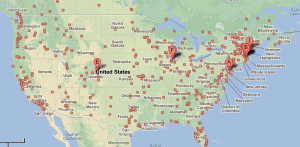
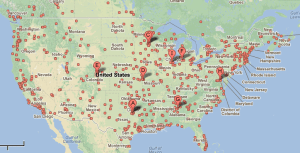
Subaru Dealerships in America. One dot = one dealer. I'm relying on Google to identify dealerships...

Subaru Dealerships in America. One dot = one dealer. I’m relying on Google to identify dealerships… Note these dealerships cluster in target markets: The Pacific Northwest, the Northeast, and the Mountainous West. Now there is newer growth in population centers like Southern California, New York/New Jersey, and Florida.
Toyota Dealerships in America. Contrasted to Subaru dealerships, they're more spread out into the Midwest, and not so heavily clustered. Toyota Dealerships in America. Contrasted to Subaru dealerships, they’re more spread out into the Midwest, and not so heavily clustered.

I suspect that part of the reason so many people own Subarus is because, historically, they were heavily promoted in the Northeast, and were great cars tailored specifically for people living in snowy, hilly areas. This resulted in a higher density of Subaru dealerships in the area. Today, while the Subaru isn’t the only good car in the snow or on the hills, the dealerships have big quotas to meet every year, hence they get lots of people to buy Subarus. It’s the dealers driving the sales.

*(How do you make asides or footnotes in blog posts?) IMS is a company that gathers information on all of the filled prescriptions from pharmacies. They make big bucks selling this information to drug companies, which they use to determine how well their drug is selling. Wards Auto gets information from dealership about each car sold in America including the dealership, the options on the car, the sticker price and the negotiated price. They sell the information back to the car manufacturers, wholesalers and dealers so they can tell how well their cars are selling in comparison to their competition.


Leave a comment

This Week in Breakfast: EBA (Everything but Anchovies)

We’ve had a long couple of weeks without Sunday Breakfast. Last Sunday, I was sick with a terrible cold, so I stayed in bed for the day and kept my germs to myself. As much as I would have loved breakfast, I was still feverish.

This week, I’m healed up, and we went into Hanover to a old-standby restaurant Everything But Anchovies, that has recently started serving a Sunday brunch. I guess EBAs has served a Saturday breakfast buffet for some time, but is only now expanding breakfast service to Sunday morning.

The service at EBAs is typically a buffet – in the evenings they have a pizza and pasta buffet set out. Following that theme, EBAs set out a brunch buffet. Since the Sunday service was rather new, the place was mostly empty at 9:30. The service picked up more toward 10am. We stayed until almost 11 and the place didn’t fill up. This was our first Brunch Buffet and so had to set the standard for diversity. The buffet included:

  • standard breakfast fare – steam tray eggs, roasted potatoes, sausage links and bacon, pancakes, a waffle machine,
  • Toast, bagels and muffins
  • Breakfast burritos (Unfortunately I didn’t have one, as good as they looked, because they all had cheese in them.)
  • Cold plate (lox, onions, capers, tomatoes)
  • Fruit salad
  • Shrimp cocktail
  • Salmon with wild rice pilaf (the lunch-like entree)
  • A collection of deli-style salads and greens salads
  • Vegetable sides like roast green beans, roast squash

EBAs also had a standard menu, but we didn’t even look at it. The buffet was pretty good, and worth the $11.95 (including drinks) price.

I’m sorry that I didn’t take any pictures. Sam and I were actually really chatty through breakfast (no TVs to distract us this week), and were well-ignored by the waitstaff, who probably struggle to make a living serving breakfast buffet. We gabbed over a long breakfast, going back for TWO plates each and ignoring our books.

My impression was that EBAs had all the benefits of a brunch buffet – fast service, great for big groups, meets different dietary needs, etc… But I admit, the buffet was missing a “star.” It needed the one dish that was so darn good that everybody had to take a bit. I’ve been to two extraordinary brunch buffets, the Buffet at the Capitol Hilton in Washington, DC (PDF), and the Brunch Buffet at Granite City Grill in Madison, WI. I could gush for hours about brunch at the Capitol Hilton. The food is excellent quality, the tea service is spot-on, and the items rotate around for great diversity. The “star” at the Capitol Hilton is the fruit parfaits – local fruits, tart yogurt and homemade granola. They bring them out in trays because everyone wants one. Plus, their croissants are very flaky and buttery. Granite City is a big indulgence – a place to goto brunch when you don’t want to eat for the rest of the day. Granite City has a egg benedict station and the chef has ingredients to make 5 or more variants on the dish. Yes, they will do Hotel Benson eggs – biscuit with ham and a poached egg, topped with cheddar-based mornay sauce. Plus, they put out sauce for everything – gravy for biscuits, au jous for the carving station, homemade ketchup for potatoes.

So missing at EBAs was the “star.” Everything was ok, but nothing was exceptional. I guess it came off more like a mid-tier hotel “hot free breakfast” rather than a coherent breakfast buffet.

I do give them a lot of credit for having a lot of seafood on the buffet: lox, roasted salmon, and shrimp.

We’ll likely go back, but probably for pizza and pasta, rather than breakfast.


Previous Breakfasts: