ReLocavore: Redefining "local"

Back to Wisconsin, my cheesehead friends


3 Comments

Sauteed Greens

I discovered years ago at Taco Bell that cooked lettuce is pretty disgusting. However, there are many more greens that are really delightful when cooked. Kale seems to be the fashionable green of the season, but spinach, turnip greens, arugula, “spicy mix” salad greens, dandelion greens and radish tops are also wonderful when cooked. However, that being said, it’s really easy to over cook greens into a disgusting blob of nastyness (think creamed spinach at a 24-hour buffet restaurant). Go easy on the heat and you can cook almost any green.

I have three different methods that I use to cook greens: the hot toss, the steam and the pourover. I think any types of greens will work with any method, but you might find ways that you like better.

Cooking Greens

Method 1 – The Hot Toss.

With the Hot Toss, you make a hot, fatty dressing and toss the greens to coat and wilt slightly.

1. Wash the greens, but leave a little moisture clinging to the leaves. It helps them cook faster.

2. Prep ingredients for the dressing. The recipe cooks quickly, so make sure to have everything set out and be ready to serve immediately. For a good hot toss, you need a very fatty dressing, so use a ratio of 4 parts fat to 1 part other stuff. Fats that work well are flavorful: butter, schmaltz, bacon grease or olive oil. For other stuff, use minced aromatics (garlic, onion, shallot), salty/umami tastes (soy sauce, anchovies, fish sauce), sweet flavors (sugar, honey, moleasses) or bitter/acidic tastes (prepared mustard, lemon/lime juice). Three combinations I like are:

  • 1 tsp minced shallot, 2 tsp honey, 1 tsp mustard with 4 tbsp butter.
  • zest of one lemon, 1 tbsp lemon juice, 1 tsp anchovy paste with 4 tbsp butter or olive oil. (especially tasty with Lacinato kale or dandelion greens.)
  • 1 tsp minced garlic, 2 tsp soy sauce, 1 tsp chinese mustard with 3 tbsp vegetable oil and 1 tbsp sesame oil.

3. Heat the fat in a nonstick skillet. Cook the aromatics (if you’re using them) until soft. Add the other flavors and whisk to combine. (This is the “hot” part.)

4. (Here comes the “toss” part.) Take the pan off the heat and add about a third of the greens, using tongs to toss them with the hot dressing. Once those greens are wilted, add another third of the greens and keep tossing with the tongs. Once those greens are coated and just beginning to wilt, add the last third and toss briefly. If the greens aren’t wilting, you might need to put the pan back on low heat to keep the dressing hot. Serve immediately.

Method 2 – The Steam

With The Steam, you steam the greens until crisp-tender then combine at the end with a simple, light sauce.

1. Like above, wash the greens and leave a little water clinging.

2. Prepare ingredients for the dressing. Unlike the hot toss, the dressing should be mostly flavorful liquids, especially vinegars and chili sauces. You can use a little fat, but don’t use very much. I don’t often use aromatics either. For each combination, use about 3 parts liquid to 1 part other stuff.

  • 3 tbsp rice wine vinegar and 1 tbsp chili garlic paste or a big squirt of sriracha
  • 2 tbsp mirin (Japanese sweet cooking wine), 1 tbsp water, 1 tbsp soy sauce, sprinkle of toasted sesame seeds
  • 3 tbsp white wine and juice of one half of a lemon.

3. Heat the pan over medium-high heat. Add all of the greens in one giant pile. Pour the liquid (vinegar, mirin/water, or wine) over the top of the greens. Quickly cover with a tight-fitting lid. The liquid will turn to steam and cook the greens. After a minute, take off the lid and turn the greens with tongs, making sure everything is wilting. Thicker greens like kale or bok choi will take another minute to steam.

4. Once the greens are tender, turn off the heat, add the rest of the dressing ingredients and toss to coat.

Method 3 – The Pourover

With The Pourover, you make a super-rich sauce or dressing and pour it over the top of the arranged greens, letting the greens wilt with the heat and allowing lots of extra sauce to pool in the bottom of the serving dish. This ain’t healthy. Sorry.

1. Again, wash your greens. However, use the salad spinner or towels to get as much moisture off as possible.

2. Arrange your greens artfully in a serving bowl with a bottom well to collect extra sauce or dressing. You can add other salad fixings to this recipe too, making into more of a meal. Some possible additions: chopped boiled egg, bacon, croutons, finely shredded or julienne cut vegetables, green onions, etc…

3. Make a really unhealthy sauce. My favorites are:

  • bacon grease with salty beef boullon (use a cube) and cider vinegar
  • Burre Blanc (lemon-butter sauce. See Child, J. Mastering the Art of French Cooking vol 1, Chapter 1.)
  • Hollandaise sauce (see above, same chapter)
  • Basic mayo, heated gently.

4. Pour the really unhealthy sauce over the greens. Really pour a LOT of it over the top. The point is to drown the boring stuff in really tasty stuff. Be generous. Serve from the bowl, and use a big spoon to add any sauce or dressing from the bottom of the bowl back on top of the individual servings of greens.


Leave a comment

Mufaletta: We ain’t f*cking around… in Sandwich Form

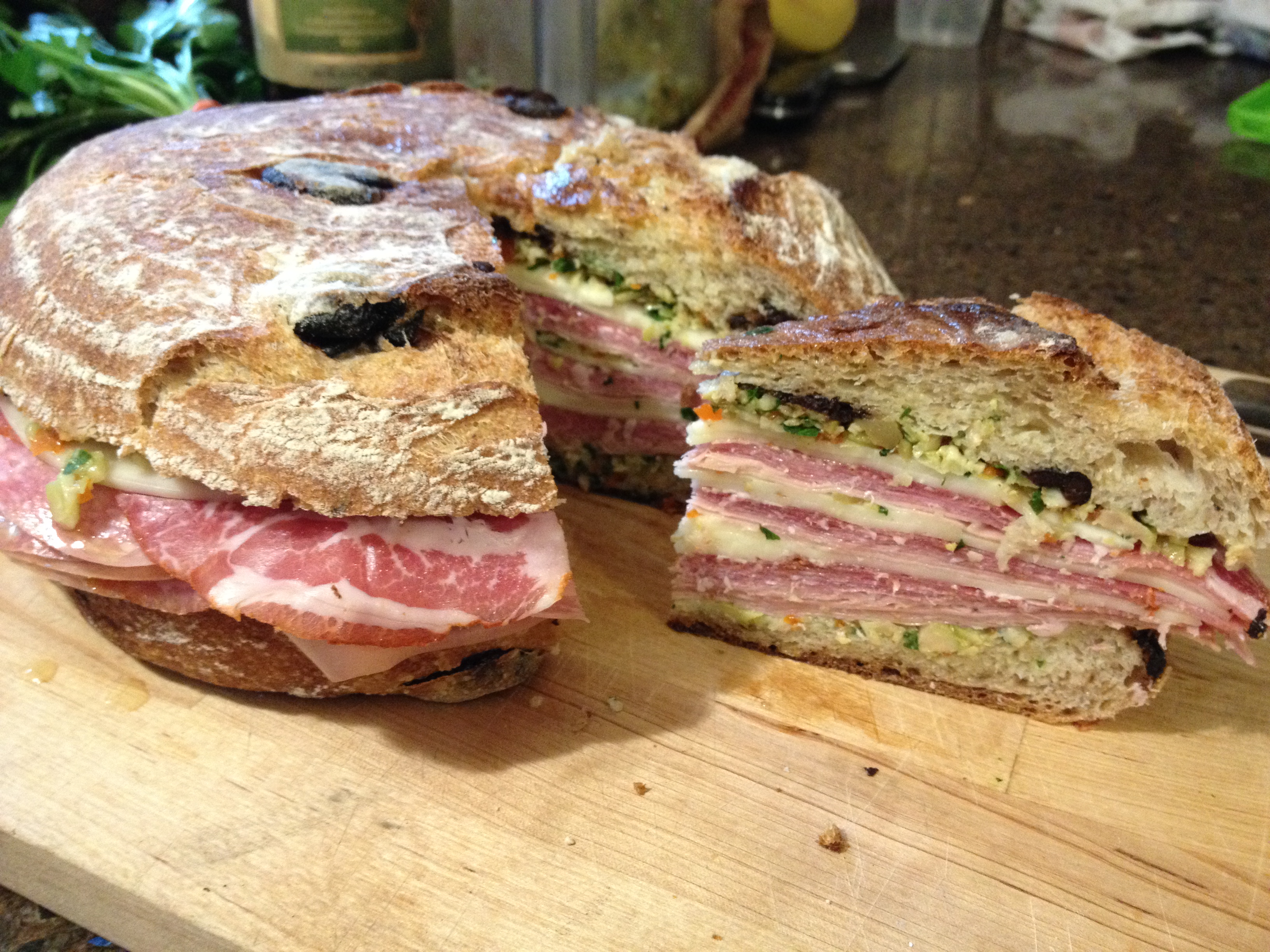
2014-06-22 18.15.05When I want a sandwich, I don’t want a little turkey on bread. I either want chicken salad on a toasted croissant or I want muffaletta. Chicken salad is tempting fate with botulism and celery seeds. Muffaletta is pure NoLa goodness.

A little history, the Central Market in New Orleans supposedly invented the muffaletta sandwich, which is typically mortadella, salami, ham, provolone or swiss cheese on a 8″-12″ round loaf of bread. The real showstopper is the “olive salad” added to the top, which is chopped olives with giardiniera, garlic, herbs and oil. The sandwich is named after the bread – a soft italian loaf with sesame seeds baked into the top, however, it seems silly today to actually just buy the bread… The sandwich is so much better. According to the daughter of the original owner of the Central Market, her father served bread, meat and cheeses to Italian immigrant farmers coming to the market to sell vegetables. Necessity being the mother of invention and all, the sandwich was more portable and easier to eat, rather than balancing the ingredients on one’s lap.

I learned to make a Muffaletta sandwich when I worked as a teenager at the now-defunct Opera House cajun restaurant in Pecatonica, IL. I remember the chef weighting the sandwiches down with gallon-sized metal cans of tomato sauce. I never remember seeing any of the tomato sauce get used in the restaurant – I think the cans were there because they were the right size and weight to make a great muffaletta.

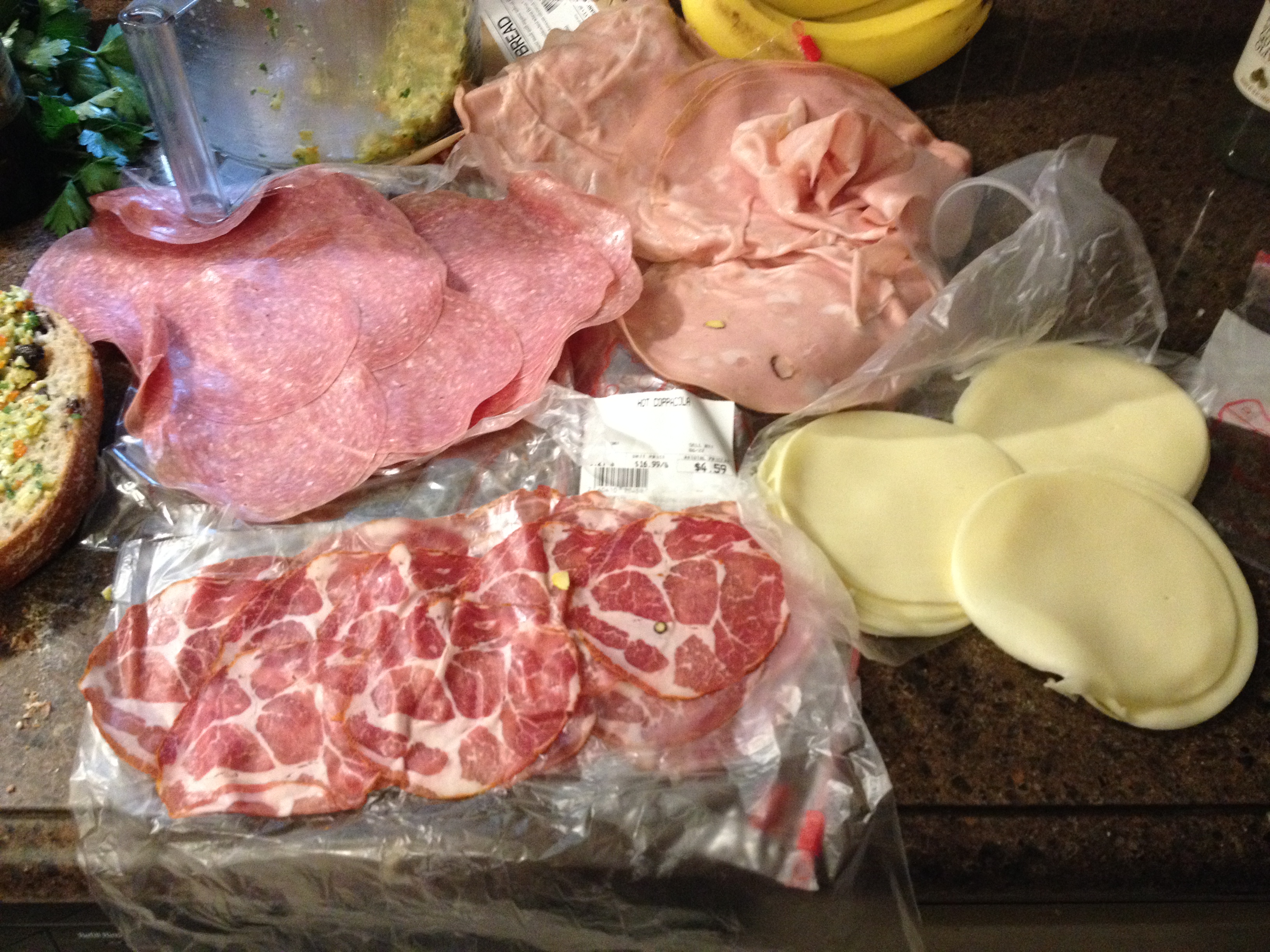
Ingredients: 1/2 lb mortadella, 1/2 lb salami, 1/4 lb hot capricola, 1/2 lb provolone cheese. All sliced thin, but not paper thin. (Not shown: olive tepenade and a large round loaf of crusty bread.)

Ingredients: 1/2 lb mortadella, 1/2 lb salami, 1/4 lb hot capricola, 1/2 lb provolone cheese. All sliced thin, but not paper thin. (Not shown: olive salad and a large round loaf of crusty bread.)


Step 1: Make olive tapenade. In a food processor, combine 3 cloves garlic, 12 oz pimento stuffed olives (drained), parsley, and olive oil. Process until chunky. Cut bread in half and hollow out the top to make more room for sandwich. Spread 2/3 tapenade onto top and bottom of bread.

Step 1: Make olive salad. In a food processor, combine 3 cloves garlic, 12 oz pimento stuffed olives (drained), fresh parsley, and olive oil. Process until chunky. Cut bread in half and hollow out the top to make more room for sandwich. Spread 2/3 tapenade onto top and bottom of bread.


Layer meats and cheeses, and remaining 1/3 of tapenade. Weight sandwich and press for 30 minutes. I'm using the Holy Trinity: McGee, Bittman and Child.

Layer meats and cheeses, and remaining 1/3 of tapenade. Weight sandwich and press for 30 minutes. I’m using the Holy Trinity: McGee, Bittman and Child. Slice into wedges and serve. Wrap leftovers (ha!) and it gets a lot better after a day in the fridge and a trip to the office in your bag.


2 Comments

Fresh Green Pea Soup with Pea Shoots

2014-06-20 18.31.09This past week, we got a bag of pea shoots in our CSA. New vegetable for me. I was just going to put them into a salad and eat them like any other green, but I decided to look around a bit for a good recipe that could feature pea shoots. I found a recipe for fresh pea soup that I was able to make with the pea shoots and a bag of frozen peas from last year. I saved a few pea shoots to put on top of the soup, but the majority of the shoots were cooked with frozen peas and chicken stock, then pureed til smooth.

Of course, pureeing hot soup in the blender, I had a few minor “explosions” and the dog apparently likes the green pea soup – he licked up every last trace from the floor. Good dog. Get your veggies.

Since I avoid the lactose sugar, I used greek yogurt instead of creme fraiche to give the soup some extra body. The process of making yogurt converts lactose sugar to lactic acid, hence, I can usually eat well-made plain yogurt without too many issues.

We served the soup warm, but not hot. I think it would have also been quite tasty chilled.


Leave a comment

Massaging vegetables: Cucumber Sunomono

Cooks Illustrated suggests massaging kale. “Kneading and squeezing” will break down cell walls. They recommend 5 minutes for standard kale and 1-2 minutes for lacinato and red Russian kale.

Here’s the thing… the Japanese technique of sunomono also uses massage to break down cell walls and make vegetables softer and more tender. The difference is the Japanese method includes salt, which helps break down cell walls and extract moisture, but then rinses the vegetables to remove the excess saltiness.

I think this calls for Sunomono, or Japanese cucumber salad! This dish is great on a hot summer day, served with cold soba noodles and iced dipping sauce.

Sunomono

Serves 2 generously.

  1. Peel, cut in half the long way and seed one cucumber. Cut into thin slices on the mandoline.
  2. Mix cucumber and 1/2 tsp salt in a large bowl. Gently rub the cucumbers with salt until they become tender, but not limp, and give away lots of liquid. Gently squeeze the cucumbers to remove any excess liquid. Save the liquid to make a dressing in step 3.
  3. In a microwave-safe glass measuring cup, measure out the cucumber liquid to get 1/4 cup. If theres too much, pour out excess. If there’s not enough, add water. Mix a pinch of dashi granules, 2 tbsp rice vinegar, 2 tbsp soy sauce and a big pinch of sugar in with the cucumber water. Microwave for 30 seconds and stir to dissolve the dashi and sugar.
  4. Arrange half of cucumber slices in the center of a bowl. Pour over a generous amount of dressing, leaving a puddle in the bottom of the bowl. If time allows, chill to be ice-cold.


Leave a comment

Yamaimo or Snot Potato

This is my first experience with yamaimo, mountain yam or slippery potato – I will affectionately call it the snot potato. Recipes for Japanese Pizza or Okonomiyaki call for a tablespoon or more of grated snot potato and grating it produces a thick mucilage which makes okonomiyaki pancakes more stretchy and elastic. See the video for proof of snottiness. On our recent trip to Boston to shop the Asian markets, we came home with a 4″ piece of yamaimo and were able to use it to cook okonomiyaki.

As far as I can tell the snot potato doesn’t have any noticeable taste or smell. But it did make our okonomiyaki more elastic and gave it a chewy texture.

Thanks to Gypsy Swing Revue for the music.


Leave a comment

Relocavore Guest Post: Shakshouka, or eggs cooked in tomato

By Sal Cania

Israeli culture is a fascinating intermixing of many traditions and their foods, in large part due to their geography, but more importantly because of the history the modern state that resides in the hotly contested region has. Early settlers hailed mostly from Eastern Europe, bringing with them many of the local foods they had incorporated into their culture after their several millennia long Diaspora. But, as is common in many settler colonial societies of the era, they fervently adopted local fare. Hummus? Palestinian. Couscous? Lebanese. Shakshouka? Tunisian. Many of these dishes are known in the United States now by their Israeli versions, and that is in no small part because of the Jewish Diaspora that has roots in many regions around the country.

135023_660790703249_2081111753_oOne dish in particular, Shakshouka, roughly translated from Arabic as a “mixture”, is a delicious composition of tomatoes, peppers, onions, cumin, and the star of the show: poached eggs. It’s currently a staple dish in many North African diets, as well as sharing traits with similar cuisine in Mexico, Turkey, and Spain. This is not surprising, since the meal is nutritious, inexpensive, and simple.

I first discovered this little gem when I traveled to Tel Aviv and Jerusalem in 2012 as part of a scouting trip for the business school I worked at. Our goal was to sample aspects of Israeli culture, food, and learn about the business climate and major industries present in their economy. As you can imagine, food and drink took center stage pretty quickly, largely because the trip organizer had planned a number of fantastic dining experiences to draw us in. Sitting in a board room at an Intel processor factory was somewhat less interesting.

Shakshouka, mainly served for breakfast on trip, was the one plate I went for each day. Alongside pita for dipping and the traditional smoked/pickled fish that Israelis love to eat for breakfast, I was easily full until 2pm. Lunch, after a morning plate of Shakshouka, was not even important. We ate it anyway, because they served plenty of other amazing treats, and kept the [Israeli] wine flowing all day long.


Fast forward to May of 2014, when my wife found this great recipe for the dish, I realized that I had actually forgotten about my Shakshouka experience. Looking to try new things to complement our usual Vermont summer evening meals, we went for it. To start out, we followed this recipe to a “T”, and it came out very well, if a bit dry, but I suspect that was because we left it on for the full simmer time. This is a meal, after having now cooked it, that I can see being extremely versatile and offering opportunities to change out ingredients without adversely changing the overall concept. See: huevos rancheros.

In this age of post-colonialism, a dish that successfully made its way around the Middle East has somewhat ironically come now to Vermont, not at the tip of a sword, but rather the internet. It’s a fitting example of the change we’ve seen over the last century, but also a reminder that some things stay the same. Plus, who wouldn’t like spicy poached eggs in tomato sauce? My fellow Italians, take note.


2 Comments

S’Mores with Homemade Marshmallows

ImageSo, I found three packets of unflavored gelatin in my pantry today. You know what that means? HOMEMADE MARSHMALLOWS! I lubed up the stand mixer, got some cooking spray and set to my task.

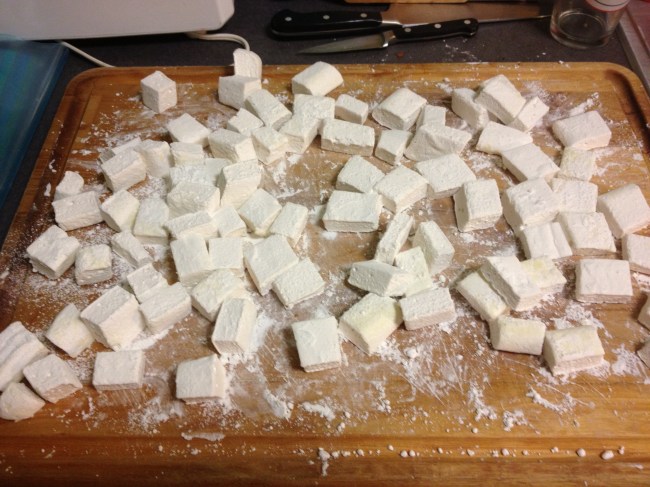
Alton Brown has an episode of Good Eats, (Season 11, Episode 12, “Puff the Magic Mallow”) where he describes making marshmallows. It’s an involved process that requires boiling a sugar syrup to the “soft ball” stage then whipping the hot sugar syrup into gelatin, and continuing to whip as the mixture cools and the gel sets with lots of air lofted in… The final product is super-duper sticky… it took Pidi about 6 minutes to lick a smear off the floor. Go ahead and follow his recipe… I cut my marshmallows into squares.

Image

Once the marshmallows were set and cut… S’mores!

Campfire-free S’Mores

Start the broiler preheating. Arrange the rack about 6″ below the heating element.

Line a cookie sheet with parchment. Arrange 2 graham cracker squares per person. Take the marshmallows and tear in half lengthwise, exposing the sticky inner surfaces. Stick marshmallows to the graham cracker. Cut chocolate into small, irregular pieces – about 1 cm on each side. Stick into the marshmallow at odd angles, leaving marshmallow exposed.

Broil for 1-3 minutes, depending on the heat of your broiler and your preference for toasted or burnt marshmallows. Since these are cooking via the direct heat of the broiler element, you can leave the oven door open an inch and watch the cooking, so you can remove the s’mores when they’re done to your liking.

Once they’re out of the oven, let them rest for a minute or two (if you can wait that long) to set up. Eat them open-faced, or press two graham crackers together to make a more traditional “sandwich” style s’more.


8 Comments

What can I do with 4 cups of tomato liquid?

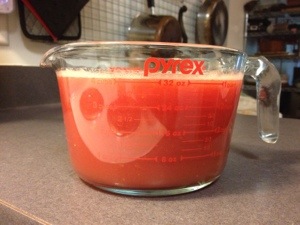
I need some ideas, quick, about what to do with 4 cups of tomato liquid. It’s not tomato purée, it’s the liquid that I got after straining the jelly and the seeds from middle of a bunch of tomatoes. It’s much thinner than tomato purée, and doesn’t have any fiber in it. What should I do with this?

20130915-153757.jpg


Leave a comment

Cucurbit Fruit Salad

Fun Fact!
Both cucumbers and cantaloupes are fruits in the cucurbit family.

Two of my favorite summer vegetables are cucumbers and cantaloupe. They are a fleeting addition to my diet. I tried canning spiced melon balls and they were mushy and disgusting. Each year, I will make one jar of refrigerator cucumber pickles, but I don’t like the texture of home-canned pickles. From July through late August, I probably eat half a cucumber and a few slices of cantaloupe every day. By September, they’re not a part of my diet, and in June, I crave a cucumber on the first hot, sunny day of the summer.

This salad comes together quickly and can get soggy if let to sit. After cutting the fruits (Yes, cucumbers are fruits…), I assemble this salad in a colander set in a bowl, and use some of the juices to toss with a simple dressing.

Cantaloupe Cucumber Salad

  • 1 medium cucumber
  • 1/4 of a cantaloupe or muskmellon
  • pinch of salt
  • 1 tsp rice wine vinegar
  1. Peel and seed the cucumber. Cut into matchsticks or julienne using a mandoline.
  2. Cut away the rind of the muskmelon. Cut into matchsticks or julienne using a mandoline. You should have about equal parts of cantaloupe and cucumber.
  3. Sprinkle the vegetables with a pinch of salt and toss in a colander set over a bowl. Allow to drain 15-20 minutes. Gently squeeze the vegetables to get the last liquid out.
  4. Mix 1 tablespoon of the drained liquid with rice wine vinegar to make a mild dressing. Toss with the vegetables and serve.


Afterthought: All this time, I was misspelling it “cantelope.”


2 Comments

Blackberry Financiers

(Hand-foraged) Blackberry Financiers. They're "rich." Get it?

(Hand-foraged) Blackberry Financiers. They’re “rich.” Get it?

Yesterday, I went on a hike with Pidi and was fortunate to come upon ripe blackberries. Usually, if I encounter ripe berries on a hike, they go straight from the bush to my lips. But I exercised a bit of self-control (only after I ate a whole bunch of them, standing in the woods…) and brought back home a heaping cupful of ripe, sweet fruits. I was going to freeze them and eventually make some wild-foraged berry jam, but Sam had the fantastic idea of making Financiers.

I got this recipe from Ripe for Dessert by David Lebowitz. For the longest time I couldn’t understand WHY they were called Financiers…

Blackberry Financiers

  • 7 tablespoon unsalted butter
  • 1 3⁄4 cup sliced blanched almonds
  • 1⁄2 cup granulated sugar
  • 1⁄2 cup powdered sugar
  • 5 tablespoon flour
  • 1⁄8 teaspoon salt
  • 4 large egg whites
  • 1⁄2 teaspoon almond extract
  • 6 ounce blackberries (or raspberries or blueberries)
  1. Position the oven rack in the center of the oven and preheat the oven to 400 degrees. Butter a 12 cup muffin tin.
  2. In a skillet, heat the butter until it begins to sizzle. Continue to cook over low heat until the edges begin to darken and the butter gives off a nutty aroma. Remove from heat.
  3. In a food processor, grind the almonds with the granulated and powdered sugars, the flour, and salt. While the processor is running, gradually pour in the egg whites and add the almond extract. Stop the machine, and add the warm butter, pulsing as you pour, until the batter is just mixed.
  4. Divide the batter evenly among the buttered muffin cups and poke 3 or 4 berries into each cake. Bake for 18 minutes, until puffy and deep golden brown. Let stand a few minutes them remove them from the pan to cool on a rack.